[Brake]: Proactive speed management on all approach situations
[Steer]: Navigate wide turns appropriate for a large vehicle
[Camera Switch]: Change view for best terrain visibility
High Score Tips
Treat every corner as requiring braking before arrival — in a large truck loaded with cargo, the combination of momentum and weight makes corner entry speed the most common cause of flipping and crashing. Begin braking for every corner before you feel it's necessary. Over-braking that produces a slow corner entry is always better than under-braking that produces a rollover.
Mountain descent requires continuous speed management, not periodic braking — on downhill mountain sections, gravity continuously adds speed to your truck. A single brake application that brings you to a safe speed is not sufficient if you then release the brake and allow gravity to re-accelerate the truck to the same dangerous speed. Maintain gentle continuous braking on extended descents.
Wide turns are correct truck driving, not mistakes — the turning radius of a large truck requires initiating turns earlier and using more road width than a car. Players who turn at the same point and radius they would in a car consistently run wide, hit obstacles, or tip. Give yourself the full available road width for every turn.
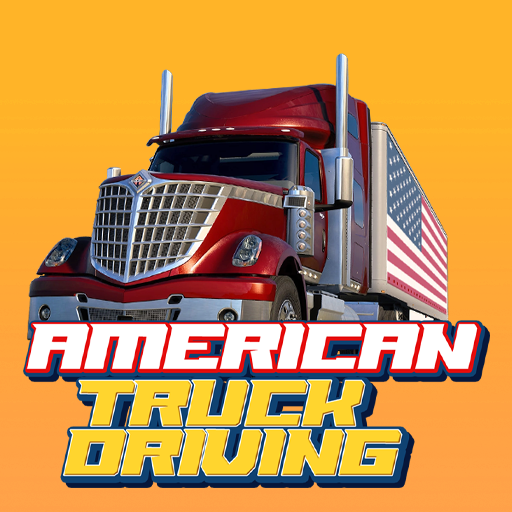
American Truck Driving
Play American Truck Driving online free at racing-limits.io. Jump into instant browser gameplay with no downloads.
American Truck Driving is a 3D truck simulation game that asks you to do something most driving games train you away from: slow down. The vehicle is large, the cargo is heavy, the terrain is varied, and the combination means that speed is consistently a liability rather than an asset. Sharp turns at speed flip large trucks; steep ramps at speed send them airborne; unexpected obstacles at speed provide no correction window. The game's challenge is not "go faster" — it's "stay in control at the speed that this specific terrain and this specific truck's physics allow."
The terrain variety across city highways, mountain roads, and other environments keeps the truck driving challenge from becoming routine. City highways test lane discipline and traffic management at the scale of a large vehicle whose turning radius and braking distance are fundamentally different from the cars sharing the road. Mountain roads test the specific physics of a heavy vehicle on steep grades — descent speed management to prevent runaway, ascent throttle management to prevent stalling, and constant awareness of the edge positions that exist on mountain roads and don't forgive mistakes.
The brake mechanic is more central to this game than in almost any other driving game. With a large, heavy vehicle loaded with cargo, braking is not a reactive emergency tool — it's an active part of every approach to every corner, every steep descent, and every intersection. Players who treat the brake as a last resort will flip, crash, and fall consistently. Players who use it proactively, as part of every movement decision, complete missions and progress levels. American Truck Driving teaches driving patience in a game format.
Key Details:
Genre:
3D Truck Driving Simulation
Difficulty Level:
Medium — patience more than reflexes
Average Play Time:
20–40 minutes per session
Best For:
Players who enjoy driving simulation games with realistic large-vehicle physics, patience-based challenge, terrain variety, and controlled cargo delivery
How to Play American Truck Driving?
Getting Started:
Begin each mission at a manageable speed — resist the temptation to accelerate to maximum immediately.
Use the brake proactively before corners, descents, and any obstacle or intersection that requires controlled approach.
On mountain terrain, manage descent speed continuously — don't wait until speed has accumulated to levels that braking can't control.
Keep your truck balanced on steep grades — tipping weight is amplified by heavy cargo and can cause flipping even at low speeds on extreme terrain.
Switch between camera angles to maintain the best view for the current terrain type and mission requirement.
Basic Controls:
Input
Action
[Accelerate]
Build speed on clear sections
[Brake]
Proactive speed management on all approach situations
[Steer]
Navigate wide turns appropriate for a large vehicle
[Camera Switch]
Change view for best terrain visibility
Objective: Complete delivery missions by driving your truck across varied terrain (city highways, mountain roads, and others) without flipping, crashing, or losing control. Prioritize balance and controlled movement over speed. Progress through levels with increasingly challenging terrain configurations.
American Truck Driving Game Features & Highlights
Realistic large-vehicle physics — truck weight, turning radius, and braking distance all behave like an actual large vehicle
Multiple terrain types — city highways, mountain roads, and additional environments each with distinct driving demands
Brake-centric gameplay — proactive braking is the game's most important recurring skill rather than a reactive emergency measure
Multiple camera angles — view switching that helps manage visibility on different terrain configurations
Wide truck selection — various truck options with distinct handling characteristics across the progression
American Truck Driving Tips & Strategies
Beginner Tips:
Treat every corner as requiring braking before arrival — in a large truck loaded with cargo, the combination of momentum and weight makes corner entry speed the most common cause of flipping and crashing. Begin braking for every corner before you feel it's necessary. Over-braking that produces a slow corner entry is always better than under-braking that produces a rollover.
Mountain descent requires continuous speed management, not periodic braking — on downhill mountain sections, gravity continuously adds speed to your truck. A single brake application that brings you to a safe speed is not sufficient if you then release the brake and allow gravity to re-accelerate the truck to the same dangerous speed. Maintain gentle continuous braking on extended descents.
Wide turns are correct truck driving, not mistakes — the turning radius of a large truck requires initiating turns earlier and using more road width than a car. Players who turn at the same point and radius they would in a car consistently run wide, hit obstacles, or tip. Give yourself the full available road width for every turn.
Advanced Strategies:
Understand your truck's balance point on lateral slopes — when the road tilts sideways, the truck's cargo weight shifts toward the low side, which lowers the rollover threshold on that side. Crossing a lateral slope that would be manageable without cargo may be dangerous with cargo. Slow significantly on any road surface with lateral tilt.
Use the engine brake on mountain descents rather than the service brake alone — engine braking (reducing throttle while in gear) provides continuous resistance on descents that supplements the service brake and reduces the workload on the braking system during extended downhill sections. A combination of engine braking and light service braking produces more controlled descent speeds than service braking alone.
Mission-specific terrain preparation — before beginning each mission, identify from the level preview which terrain type is involved and what the primary challenge will be. A city highway mission requires traffic management focus; a mountain mission requires descent-speed management focus. Mentally preparing for the specific challenge before starting produces calmer, more controlled driving than discovering the terrain's character mid-mission.
What to Watch Out For:
Cargo load changing vehicle behavior — loaded cargo shifts the truck's center of gravity upward and toward the cargo's position in the trailer. A fully loaded truck requires earlier braking, wider turns, and more conservative lateral slope management than an unloaded one. If a mission involves cargo, calibrate all your movement decisions to the loaded truck's behavior rather than your instincts from the unloaded configuration.
Speed buildup on subtle descents — not every downhill section is visually obvious as a descent. Gentle grades that are barely perceptible visually can still continuously add speed to a heavy truck in a way that a car wouldn't notice. If your truck feels like it's gradually accelerating without throttle input, you're on a descent — engage braking before the accumulated speed requires an emergency stop.
American Truck Driving Game Elements Explained
Large-Vehicle Physics System: American Truck Driving's physics model is specifically calibrated for the dynamics of a large, heavy vehicle with loaded cargo. This creates several behavioral differences from the standard car-physics models that most driving games use. Braking distances are significantly longer — the combined momentum of truck and cargo requires more distance to dissipate than a passenger car's equivalent speed. Turning radius is wider — the truck's wheelbase and length require initiating turns earlier and using more road width than compact vehicles. Rollover threshold is lower in lateral situations — the high center of gravity from the truck cab and loaded trailer means tilted road surfaces and sharp corners at speed produce rollover risk that flat roads and gentle turns don't. The physics model's fidelity to these large-vehicle behaviors is what makes the game's "slow down" design philosophy feel physically justified rather than arbitrarily restrictive.
Terrain-Specific Driving Demands: The multiple terrain types in American Truck Driving each create distinct driving challenges that test different aspects of truck control skill. City highway terrain tests traffic management and lane discipline at the scale of a vehicle significantly larger than most traffic — overtaking, turning, and intersection navigation all require the wider margin a truck needs. Mountain terrain tests gradient management — both ascent (throttle management to maintain climbing momentum without stalling) and descent (speed management against continuous gravity acceleration that a heavy truck experiences more severely than lighter vehicles). Other terrain types introduce their own specific challenges within the same truck physics framework, ensuring that competence on one terrain type doesn't automatically translate to mastery of all others.
Brake-Centric Design Philosophy: American Truck Driving's explicit instruction that "safety and staying in control are more important than speed" is a design philosophy that inverts the typical racing game's incentive structure. In most driving games, braking is a limitation — a concession to obstacle reality that interrupts the preferred state of maximum acceleration. In American Truck Driving, braking is a skill — the primary tool for managing a large vehicle's momentum in a way that keeps the mission proceeding safely rather than ending it in a crash. The proactive brake usage that the game teaches — brake before it's necessary, not when it is — requires a mindset shift from most driving game habits. Players who make this shift successfully find that the game's missions become progressively more manageable; players who resist it find that the truck's physics consistently punish the reflexive speed-first approach that other games reward.
American Truck Driving Frequently Asked Questions
Q: Why does my truck keep flipping? A: Truck flipping in American Truck Driving results from one of three conditions: too much speed in corners (approach all corners with braking before arrival), excessive speed on lateral slopes (the cargo weight lowers rollover threshold significantly on tilted surfaces), or sharp steering input at speed (large vehicles require gradual steering rather than sharp direction changes at any significant speed).
Q: How fast should I drive? A: There is no single correct speed — the right speed depends on the terrain ahead. On flat, clear city highway, moderate speed is manageable. Before corners, on descents, or on any terrain with lateral tilt, the correct speed is whatever allows a controlled stop or turn within the available space. If you're uncertain whether your current speed is safe, reduce it proactively rather than discovering the answer by losing control.
Q: How do I manage mountain descents? A: Use continuous gentle braking rather than periodic heavy braking. On extended descents, gravity continuously adds speed — releasing the brake after a single speed reduction allows gravity to re-accelerate the truck. Combine engine braking (released throttle while in gear) with light service braking to maintain a controlled descent speed throughout the downhill section.
Q: Is American Truck Driving compatible with mobile devices? A: American Truck Driving's simulation controls may support touch input on mobile browsers — check the in-game control options. Desktop play typically provides the most precise throttle and braking management for the terrain demands of mountain roads and city traffic.
Q: How do I complete missions faster? A: Counterintuitively, the fastest mission completions come from never crashing rather than from driving faster. A crash requires a restart from the mission beginning; a controlled but slower completion still completes. Accept the time cost of conservative speed management in exchange for the certainty of mission completion. Once you know a mission's terrain profile well enough to identify which sections support higher speed, selectively increase speed only on those sections.
Related Games Like American Truck Driving You Might Enjoy
If you like American Truck Driving, you might also enjoy:
Truck Driver Snowy Roads - It delivers a similar driving challenge with quick browser-based racing sessions.
Extreme Car City Driving - It delivers a similar driving challenge with quick browser-based racing sessions.
Driftio - It delivers a similar driving challenge with quick browser-based racing sessions.
 Drift Frenzy
 Drift Rush
 Arcade Glide
 Track Dash
 Retro Rush
 Escape Road 3
 Wave Rider
 Traffic Road
 Escape Road City 2
 Bike Xtreme
 Escape Road 2
 Traffic Rally
 Tap Drift
 Drive Mad
 Wheelie Master
 Wheelie Party
 Moto X3M
 Street Wheelie
 Car Chaos
 Escape Drive
 Blocky Rider
 Mad Pursuit
 Mad Racers
 Chase Rush
 Smashy Road
 Driftio
 Night City Racing
 Hill Climb Racing
 Drift Hunters
 Smash Karts
 GT Cars Mega Ramps
 Motorcycle Racer Road Mayhem
 Funny Mad Racing