Speed is your primary defense — the pursuer closes the gap whenever you slow down, and gains ground on every obstacle collision. Consistent speed through clean navigation is more effective than maximum speed interrupted by frequent obstacle contacts.
Read the slope ahead, not the obstacle at your current position — by the time an obstacle is directly in front of your skier, your ideal response window has passed. Scan the slope 2–3 seconds ahead and begin steering adjustments early rather than reactively.
Complete Penguin Peaks fully before moving on — the 54 challenges in the first map are specifically designed to build the skiing mechanics and obstacle reading skills that all subsequent maps require. Rushing to unlock later maps before these fundamentals are solid produces consistent early failures on the harder content.
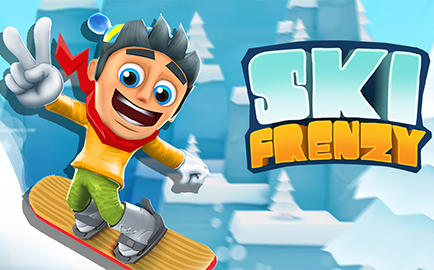
Ski Frenzy
Play Ski Frenzy online free at racing-limits.io. Jump into instant browser gameplay with no downloads.
Ski Frenzy is a survival skiing game with a simple, terrifying premise: something enormous is coming down the mountain behind you, and your only option is to ski faster than it can follow. In the opening map, it's a snowstorm and avalanche. Subsequent maps replace the pursuer with a lavalanche, a desert tornado, ravenous Halloween pumpkins, and eventually the surreal challenges of the North Pole and the Moon. The visual world changes dramatically across six maps, but the fundamental tension never does — stay ahead of what's chasing you, or it ends.
The game's scale is what sets it apart from most browser survival runners. Over 300 challenges across six maps — Penguin Peaks, Jurassic Lark, Twister Canyon, Monster Mountain, North Pole, and Lunar Lookout — provide enough structured content to sustain a dedicated player for a significant time investment. Each map isn't just a visual reskin of the same challenge: Jurassic Lark's lavalanche behaves differently from Penguin Peaks' snowstorm; Monster Mountain's hungry pumpkins introduce active threat behavior beyond a passive pursuing mass; Lunar Lookout's moon-surface physics change what ski movement feels like at a fundamental level. The variety is genuine.
The progression structure across 300+ challenges creates a different relationship with the game than an endless runner provides. Each challenge has a defined completion condition, which means success is binary and tangible — you finished it, or you come back and try again. The satisfaction of completing challenge 54 of Penguin Peaks is different from simply surviving longer than last time; it's a specific achievement in a structured progression toward the full 300+ completion that motivates differently. Ski Frenzy is a game with real scope that reveals itself progressively, and it's earned the number of challenges it offers.
Key Details:
Genre:
Survival Runner / Action
Difficulty Level:
Progressive (varies by map and challenge number)
Average Play Time:
10–20 minutes per session
Best For:
Players who enjoy survival runner games with structured challenge progression, diverse world themes, and high content volume
How to Play Ski Frenzy?
Getting Started:
Begin in Penguin Peaks — the starting map with 54 challenges that introduces the game's skiing mechanics and pursuer-avoidance structure.
Control your skier to navigate down the mountain slope away from the pursuing snowstorm/pursuer.
Steer left and right to avoid obstacles on the slope — rocks, trees, barriers, and terrain features that slow you down or end the challenge.
Maintain maximum safe speed — too slow and the pursuer catches you; precise obstacle navigation keeps your speed consistent.
Complete each challenge's specific objective to unlock the next, progressively working through all six maps.
Basic Controls:
Key
Action
Left Arrow / A
Steer Left
Right Arrow / D
Steer Right
[Up/Accelerate]
Increase Speed
[Down/Brake]
Reduce Speed
Objective: Outrun the pursuing threat on each challenge's slope by navigating obstacles cleanly and maintaining forward speed. Complete each challenge's specific conditions to advance through Ski Frenzy's 300+ structured challenges across six distinct maps.
Ski Frenzy Game Features & Highlights
300+ structured challenges — one of the highest challenge counts among browser survival runner games, with completion objectives rather than pure distance scores
Six distinct maps — Penguin Peaks, Jurassic Lark, Twister Canyon, Monster Mountain, North Pole, and Lunar Lookout each with unique themes, pursuers, and physics
Diverse pursuer types — snowstorm/avalanche, lavalanche, desert tornado, hungry pumpkins, and more — each with distinct behavior patterns
Progressive map unlocks — completing challenges in each map unlocks the next, maintaining long-term progression motivation
Thematic variety — environments span winter mountain, Jurassic forest, desert canyon, Halloween setting, Arctic North Pole, and lunar surface
Ski Frenzy Tips & Strategies
Beginner Tips:
Speed is your primary defense — the pursuer closes the gap whenever you slow down, and gains ground on every obstacle collision. Consistent speed through clean navigation is more effective than maximum speed interrupted by frequent obstacle contacts.
Read the slope ahead, not the obstacle at your current position — by the time an obstacle is directly in front of your skier, your ideal response window has passed. Scan the slope 2–3 seconds ahead and begin steering adjustments early rather than reactively.
Complete Penguin Peaks fully before moving on — the 54 challenges in the first map are specifically designed to build the skiing mechanics and obstacle reading skills that all subsequent maps require. Rushing to unlock later maps before these fundamentals are solid produces consistent early failures on the harder content.
Advanced Strategies:
Learn the pursuer's behavior pattern per map — each map's pursuer has different acceleration and terrain interaction characteristics. The snowstorm in Penguin Peaks responds differently to player speed changes than Jurassic Lark's lavalanche. Developing a specific mental model for each pursuer's closing behavior on each map improves your speed-calibration decisions throughout each challenge.
Use obstacle-free sections to rebuild clearance — when the slope opens into a section without significant obstacles, push maximum speed to build buffer distance from the pursuer. This clearance is the resource you spend navigating the dense obstacle sections safely — you trade buffer distance for obstacle clearance time. Rebuilding it in open sections is as important as spending it carefully in obstacle sections.
Lunar Lookout requires recalibrated jump expectations — the moon map's reduced gravity changes your skier's movement profile in ways that terrain maneuvers calibrated for Earth-gravity slopes won't handle correctly. Spend extra time on early Lunar Lookout challenges specifically learning how the physics differ before applying the aggressive navigation style that works on terrestrial maps.
What to Watch Out For:
Monster Mountain's active pumpkin threats — unlike the passive pursuers in earlier maps, Monster Mountain's hungry pumpkins can approach from lateral directions, not just from behind. This changes the threat model from single-direction avoidance to multi-directional awareness. Check your lateral flanks in Monster Mountain challenges, not just your rear clearance.
Speed overcorrection after an obstacle contact — touching an obstacle slows you down, which allows the pursuer to close distance. The instinct to immediately accelerate maximally to recover that distance can produce a second obstacle contact before your steering has stabilized from the first. Recover to controlled speed before pushing maximum acceleration.
Ski Frenzy Game Elements Explained
Map & Pursuer System: The six maps in Ski Frenzy each deliver a distinct version of the core pursuit mechanic through different visual environments and different pursuer behaviors. Penguin Peaks establishes the baseline with a traditional snowstorm and avalanche pursuer on a winter mountain slope — the pursuer advances at a pace that responds predictably to the player's speed. Jurassic Lark introduces the lavalanche — a heat-based flowing pursuer that may interact differently with terrain features than the snow-based original. Twister Canyon replaces the vertical pursuer with a desert tornado in a canyon environment, adding lateral pursuit dynamics alongside the standard downhill pressure. Monster Mountain's Halloween setting introduces active pursuers — hungry pumpkins that are not simply masses following from behind but entities with approach behavior that adds a lateral threat dimension. North Pole and Lunar Lookout complete the progression with the Arctic and space environments that represent the game's highest-difficulty content.
Challenge Structure: Ski Frenzy's 300+ challenges across six maps represent a structured completion framework rather than an infinite score-chasing format. Each challenge has a specific objective that defines its completion — surviving a defined distance with a defined obstacle density, navigating a specific terrain configuration, or meeting particular performance thresholds within the challenge's slope. This binary completion model — done or not done — creates a different motivational relationship than endless runners: every session is either a completion of one or more specific challenges or practice toward that completion. The challenge numbering within each map (Penguin Peaks: 54, Jurassic Lark: 54, Twister Canyon: 54, Monster Mountain: 34, North Pole: 60, Lunar Lookout: 58) totals over 300 individual completion objectives, each representing a specific micro-achievement within the game's larger progression arc.
Physics & Terrain Variation: The terrain variety across Ski Frenzy's six maps isn't purely cosmetic — different surface types and gravity environments produce measurably different skiing physics that require recalibration between maps. Snow surfaces in Penguin Peaks have specific friction characteristics that affect turning radius and speed loss on obstacle contact. Desert surfaces in Twister Canyon may interact differently with steering inputs. The moon environment in Lunar Lookout represents the most dramatic physics departure: reduced gravitational acceleration changes jump arcs, landing behaviors, and the relationship between steering input and directional change in ways that render terrestrial-calibrated skiing instincts temporarily unreliable. The physics variation is the mechanism by which later maps present genuinely new challenges beyond simply having more or denser obstacles — they present a physics environment that experienced players must relearn from new first principles.
Ski Frenzy Frequently Asked Questions
Q: How many challenges does Ski Frenzy have in total? A: Ski Frenzy features over 300 challenges distributed across six maps: Penguin Peaks (54), Jurassic Lark (54), Twister Canyon (54), Monster Mountain (34), North Pole (60), and Lunar Lookout (58). Additional challenges may be added in future updates.
Q: What should I do if the pursuer keeps catching me? A: Focus on obstacle-avoidance consistency rather than maximum speed — every obstacle contact slows you and allows the pursuer to close distance. A clean run at 80% of maximum speed consistently outperforms a maximum-speed run interrupted by three obstacle contacts. Practice the specific section where you're losing speed until you can navigate it cleanly.
Q: How do I unlock new maps? A: Progress through the challenges in each map to unlock the subsequent one. Complete challenges in Penguin Peaks to unlock Jurassic Lark, and continue through the progression. Each map's challenges must be engaged progressively — later challenges in a map unlock as earlier ones are completed.
Q: Is Ski Frenzy compatible with mobile devices? A: Ski Frenzy uses keyboard controls and is best suited for desktop and laptop browsers. Mobile play requires a connected external keyboard for reliable steering input during the game's fast-paced slope navigation.
Q: Why does the moon map feel different from the other maps? A: Lunar Lookout uses a reduced-gravity physics model that reflects the moon's lower gravitational acceleration compared to Earth. This changes how your skier moves, turns, jumps, and lands compared to the terrestrial maps. Expect to spend additional time on early Lunar Lookout challenges learning the new physics profile before applying the navigation aggression that works in earlier maps.
Related Games Like Ski Frenzy You Might Enjoy
If you like Ski Frenzy, you might also enjoy:
Black Holeio - It is another easy-to-start browser game with strong replay value.
Wormateio - It is another easy-to-start browser game with strong replay value.
Roshambo - It is another easy-to-start browser game with strong replay value.

 Drift Frenzy
 Drift Rush
 Arcade Glide
 Track Dash
 Retro Rush
 Escape Road 3
 Wave Rider
 Traffic Road
 Escape Road City 2
 Bike Xtreme
 Escape Road 2
 Traffic Rally
 Tap Drift
 Drive Mad
 Wheelie Master
 Wheelie Party
 Moto X3M
 Street Wheelie
 Car Chaos
 Escape Drive
 Blocky Rider
 Mad Pursuit
 Mad Racers
 Chase Rush
 Smashy Road
 Driftio
 Night City Racing
 Hill Climb Racing
 Drift Hunters
 Smash Karts
 GT Cars Mega Ramps
 Motorcycle Racer Road Mayhem
 Funny Mad Racing