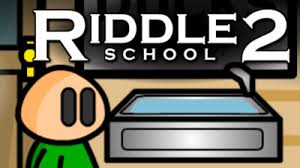
Left Click: Direct Phil / Examine / Collect / Interact
Red Arrows: Navigate between accessible rooms
High Score Tips
Talk to every character before picking up items — characters in Riddle School 2 reveal what they need through dialogue. Collecting items before you know what they're for is less efficient than understanding the puzzle chain first and then collecting deliberately. Phil's interactions with characters provide the puzzle's roadmap.
Click everything in each room — items in point-and-click adventures are sometimes positioned in unexpected places. A systematic click-through of each room's interactive elements ensures you haven't missed a collectible that will be needed later in the chain.
Follow the red arrows to new rooms before assuming you're stuck — when a current room seems exhausted of useful interactions, the red arrows will indicate adjacent rooms that haven't been explored yet. The puzzle chain often requires items from multiple rooms that are only connected once you've gathered all the pieces.
Riddle School 2
Play Riddle School 2 online free at racing-limits.io. Jump into instant browser gameplay with no downloads.
Riddle School 2 is a point-and-click adventure game with a premise that most students will find immediately sympathetic: Phil is stuck in music class, it's boring, the door is locked, and he needs to find a way out. What unfolds from that simple setup is a genuinely charming school exploration puzzle where every room holds characters with needs, items with hidden purposes, and a sequence of small solutions that add up to one successful school escape.
The game is a complete, self-contained adventure story with real character and narrative warmth. Phil's classmates and teachers aren't obstacles — they're characters with their own distinct personalities who need specific things before they'll cooperate with Phil's escape plan. The fat guy blocking the door wants a cookie. The person stuck in the toilet needs toilet paper. These aren't arbitrary fetch quests; they're logical transactions in a school environment where every character's request makes sense given who they are and where they're standing. Following the chain of solutions from one character's need to the next creates a satisfying logical progression that players of all ages can navigate.
Riddle School 2 occupies a charming niche in browser gaming that has grown rare: the short, complete, expertly paced point-and-click adventure. It doesn't overstay its welcome, doesn't introduce mechanics it can't fully explore, and delivers its adventure with a consistent tone that's funny without being cynical and challenging without being frustrating. The red arrows that guide Phil's available movements ensure the puzzle never becomes an inventory maze, keeping the focus on the solutions rather than the navigation. If you've never played a Riddle School game before, this is a perfect entry point — and if you've been waiting to revisit Phil's school escape, he's exactly as charming as you remember.
Key Details:
Genre:
Point-and-Click Adventure / Puzzle
Difficulty Level:
Easy–Medium
Average Play Time:
15–30 minutes (full completion)
Best For:
All ages; fans of point-and-click adventures, casual puzzle players, and anyone who enjoys short, complete story-driven games
How to Play Riddle School 2?
Getting Started:
Left-click anywhere on the screen to direct Phil and make selections — all navigation and item interaction in Riddle School 2 is mouse-driven.
Follow the red arrows that indicate where Phil can move — these mark all accessible areas from your current position.
Explore each room by clicking on characters to hear what they say and clicking on objects to examine or collect them.
Listen carefully to what each character tells you — their requests and comments are the puzzle clues that direct your next action.
Use collected items on characters or objects when you've identified the correct application — solving each character's need unlocks the next step toward Phil's escape.
Basic Controls:
Input
Action
Left Click
Direct Phil / Examine / Collect / Interact
Red Arrows
Navigate between accessible rooms
Objective: Help Phil escape school by exploring every accessible room, collecting key items, solving each character's specific request, and ultimately finding the key that opens the locked exit door. Complete the full chain of solutions to see Phil reach the world outside school.
Riddle School 2 Game Features & Highlights
Complete narrative adventure — a fully realized school escape story with consistent tone, memorable characters, and a satisfying conclusion
Character-based puzzle chain — each NPC has a specific need that must be resolved in a logical sequence that builds toward the final escape
Red arrow navigation — accessible movement indicators keep the puzzle focused on solution logic rather than map navigation confusion
Appropriate for all ages — humor and challenge calibrated for a broad audience without content concerns
Self-contained experience — a complete adventure with a defined beginning, middle, and end that respects the player's time
Riddle School 2 Tips & Strategies
Beginner Tips:
Talk to every character before picking up items — characters in Riddle School 2 reveal what they need through dialogue. Collecting items before you know what they're for is less efficient than understanding the puzzle chain first and then collecting deliberately. Phil's interactions with characters provide the puzzle's roadmap.
Click everything in each room — items in point-and-click adventures are sometimes positioned in unexpected places. A systematic click-through of each room's interactive elements ensures you haven't missed a collectible that will be needed later in the chain.
Follow the red arrows to new rooms before assuming you're stuck — when a current room seems exhausted of useful interactions, the red arrows will indicate adjacent rooms that haven't been explored yet. The puzzle chain often requires items from multiple rooms that are only connected once you've gathered all the pieces.
Advanced Strategies:
Connect characters' requests to inventory before returning — when a character tells you they need something, mentally trace where that item might be before leaving their room. Often the item is in an adjacent or recently visited room, and knowing its likely location before searching reduces backtracking time.
Item applications are always logical in context — if you have an item and can't figure out where to use it, think about who would logically want or need that item given their situation. Riddle School 2's puzzle solutions always make contextual sense; if a solution feels arbitrary, you may be missing a character interaction that makes the connection clearer.
The order matters — some puzzle steps must be completed before others become available. If you've collected items and talked to characters but the next step isn't accessible, a prerequisite action may not be complete. Revisit characters you've already spoken to — their dialogue often updates after you've completed related puzzle steps.
What to Watch Out For:
Teachers who urge Phil back to class — Phil's teachers will periodically tell him to return to class. This is narrative flavor, not a failure condition — Phil continues exploring regardless of teacher objections. Don't interpret teacher interactions as dead ends.
Rooms that appear explored but have remaining interactions — some rooms contain items or interactive elements that only become accessible after completing a specific earlier puzzle step. Returning to previously visited rooms after major puzzle completions often reveals newly accessible content.
Riddle School 2 Game Elements Explained
Character Puzzle Chain: The character-based puzzle structure is Riddle School 2's primary design approach and the mechanism that gives the game its narrative coherence. Rather than scattering items across the school for Phil to collect and apply in arbitrary combinations, the game builds a chain of character needs: Character A needs Item X, which is held or gated by Character B, who needs Item Y, which requires solving Character C's situation first. This chain structure means that every item collection and every character interaction has a clear purpose within the logical progression — nothing is a red herring, and nothing requires lateral thinking that contradicts the established rules of the school environment. The chain's sequential nature means players who listen to every character dialogue before acting have a clear map of what to do next at every stage; players who rush through interactions without listening tend to collect items without knowing their purpose and miss the chain's connective logic.
Navigation & Interface: The point-and-click interface in Riddle School 2 uses a left-click-for-everything approach that keeps the mechanical demands minimal and the puzzle focus central. Phil moves to wherever you click within the accessible area; item interactions trigger on click; character conversations start on click. The red arrows that indicate available movement directions serve as a navigational guide that prevents the frustration common in older point-and-click adventures where players wander aimlessly looking for exits. Every transition is visible and deliberate. The interface design reflects the game's overall philosophy: reduce friction between the player and the puzzle, so that the experience is entirely about finding the next solution rather than fighting with the control scheme. For players new to point-and-click adventures, Riddle School 2 is an accessible entry point precisely because its interface never becomes an obstacle.
Tone & Narrative: Riddle School 2 maintains a consistent comedic tone that comes from character personality rather than forced jokes. Phil's situation — a student so bored by music class that he engineers a full school escape — is inherently relatable, and the characters he encounters on the way are written with enough personality to feel like residents of a real school rather than puzzle mechanisms wearing character costumes. The fat guy at the door who won't move until he gets a cookie is funny because it's a recognizable type of person in an entirely believable position. The person stuck in the toilet needing assistance is absurd but never mean-spirited. The teachers who insist Phil return to class despite his obvious escape preparations add gentle tension without real threat. This tonal consistency — funny without trying too hard, challenging without being obtuse — is what makes Riddle School 2 one of the most fondly remembered browser adventure games of its era, and why it holds up as well today as when it was first released.
Riddle School 2 Frequently Asked Questions
Q: How do I move Phil around the school? A: Left-click anywhere accessible on the screen to direct Phil to that location. Follow the red arrows to move between rooms — they indicate all available exits and navigation points from your current position. All other interactions (talking to characters, collecting items, using objects) are also performed with left-click.
Q: What should I do if I'm stuck and can't figure out the next step? A: First, make sure you've spoken to every character in every accessible room — character dialogue updates as you complete puzzle steps and often directly tells you what you need next. Second, check that you've explored all rooms accessible from the current position. Third, revisit characters you've already spoken to — their dialogue changes after related puzzle completions and may now provide the clue that was missing before.
Q: Is Riddle School 2 a complete game or part of a series? A: Riddle School 2 is a self-contained adventure with its own complete narrative — you don't need to have played Riddle School 1 to enjoy or complete it. It is part of a series of Riddle School games featuring the same character, Phil, but each entry stands independently as its own school escape adventure.
Q: Is Riddle School 2 compatible with mobile devices? A: Riddle School 2 uses point-and-click mechanics that translate well to touchscreen — tapping functions identically to left-clicking for movement, item collection, and character interaction. The game is playable on mobile browsers.
Q: How long does it take to complete Riddle School 2? A: A first playthrough of Riddle School 2 typically takes 15–30 minutes depending on how quickly you work through the puzzle chain. The game is designed as a complete, satisfying adventure within a short session — it doesn't pad its content beyond what the story requires.
Related Games Like Riddle School 2 You Might Enjoy
If you like Riddle School 2, you might also enjoy:
Tilemanio - It offers a related skill loop where timing, planning, or steady improvement matters.
Geoguessr - It offers a related skill loop where timing, planning, or steady improvement matters.
Brainrot Merge - It offers a related skill loop where timing, planning, or steady improvement matters.

 Drift Frenzy
 Drift Rush
 Arcade Glide
 Track Dash
 Retro Rush
 Escape Road 3
 Wave Rider
 Traffic Road
 Escape Road City 2
 Bike Xtreme
 Escape Road 2
 Traffic Rally
 Tap Drift
 Drive Mad
 Wheelie Master
 Wheelie Party
 Moto X3M
 Street Wheelie
 Car Chaos
 Escape Drive
 Blocky Rider
 Mad Pursuit
 Mad Racers
 Chase Rush
 Smashy Road
 Driftio
 Night City Racing
 Hill Climb Racing
 Drift Hunters
 Smash Karts
 GT Cars Mega Ramps
 Motorcycle Racer Road Mayhem
 Funny Mad Racing