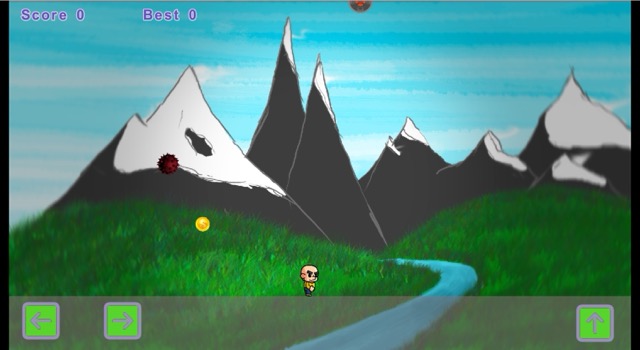
Keep moving at all times — a stationary character is easy for the game's spike ball pattern to pin down. Continuous lateral movement creates a moving target that's significantly harder to corner than a character that stands still and reacts.
Read the next spike ball before the current one lands — the most effective survival posture in Run and Jump is always tracking the next incoming threat while managing the current one. Players who focus only on the ball immediately threatening them are consistently surprised by the one arriving from a different direction behind it.
Coins disappear — don't chase them indefinitely — coins that appear at risky positions have a timer before they vanish. If a coin is surrounded by spike ball trajectories when it appears, the collection window will often close before a safe path to it exists. Don't extend your exposure trying to collect a coin whose timer is nearly expired.
Run And Jump
Play Run And Jump online free at racing-limits.io. Jump into instant browser gameplay with no downloads.
Run and Jump is a 2D survival game built around one escalating threat: spiked balls. They fall from above, they fly from the sides, they arrive from multiple directions simultaneously, and their numbers increase without any upper limit. Your character runs, jumps, and collects coins on a platform that offers no hiding places and no recovery windows — a single spike ball contact ends the run. The game's challenge is not complicated, but it is unrelenting, and the pressure it generates from that simple premise is entirely genuine.
The coin collection system adds a secondary dimension that creates its own tension within the survival challenge. Coins appear across the platform and above it — jumping higher by pressing the Up Arrow multiple times brings coins within reach that ground-level play would miss. But every jump to collect a coin is also a moment of reduced lateral mobility, and the spike balls that track from multiple directions don't pause while you're in the air. The decision of whether any specific coin is worth the exposure its collection creates is a recurring micro-judgment that runs through every run.
Run and Jump is one of those games that's immediately understandable, immediately challenging, and significantly more addictive than its visual simplicity suggests. The escalating spike ball count ensures that the experience always gets harder — there's no plateau of comfortable survival, only the question of how long you can manage the growing chaos before one ball finds a gap you couldn't close. It's a game that respects your reflexes enough to give them a genuine workout.
Key Details:
Genre:
2D Survival / Reflex Platformer
Difficulty Level:
Easy start, Hard at distance
Average Play Time:
5–10 minutes per session
Best For:
Players who enjoy fast-paced reflex survival games with escalating difficulty and coin collection scoring
How to Play Run And Jump?
Getting Started:
Use the Left and Right Arrow keys to move your character horizontally across the platform.
Press the Up Arrow key to jump — a single press produces a standard jump; pressing multiple times in quick succession jumps higher.
Avoid all spike balls, which fall from above and fly in from multiple directions — contact with any spike ball ends the run immediately.
Collect coins that appear on the platform and above it — each coin adds one point to your score.
Survive as long as possible as the number and variety of spike ball directions increase continuously.
Basic Controls:
Key
Action
Left Arrow
Move Left
Right Arrow
Move Right
Up Arrow (once)
Standard Jump
Up Arrow (multiple)
Higher Jump
Objective: Survive as long as possible against continuously increasing spike ball numbers and approach directions. Collect coins to accumulate score — each coin equals one point — while prioritizing survival over collection when spike ball pressure becomes critical.
Run And Jump Game Features & Highlights
Escalating spike ball system — ball count increases continuously with no ceiling, ensuring the difficulty never plateaus
Multi-directional threats — spike balls approach from above and from sides, demanding 360-degree threat awareness rather than single-direction focus
Variable jump height — single vs. multiple Up Arrow presses produces different jump heights, enabling coin collection at different altitudes
Coin-based scoring — each collected coin adds to your score, with airborne coins rewarding the risk of higher jumps
Instant-death contact — any spike ball hit ends the run with no health buffer, keeping each moment of the game genuinely consequential
Run And Jump Tips & Strategies
Beginner Tips:
Keep moving at all times — a stationary character is easy for the game's spike ball pattern to pin down. Continuous lateral movement creates a moving target that's significantly harder to corner than a character that stands still and reacts.
Read the next spike ball before the current one lands — the most effective survival posture in Run and Jump is always tracking the next incoming threat while managing the current one. Players who focus only on the ball immediately threatening them are consistently surprised by the one arriving from a different direction behind it.
Coins disappear — don't chase them indefinitely — coins that appear at risky positions have a timer before they vanish. If a coin is surrounded by spike ball trajectories when it appears, the collection window will often close before a safe path to it exists. Don't extend your exposure trying to collect a coin whose timer is nearly expired.
Advanced Strategies:
Develop a default lateral drift direction — at high spike ball density, continuous unidirectional movement through the platform creates a predictable spacing pattern for spike ball avoidance that's more sustainable than reactive bidirectional dodging. Develop a natural drift direction (typically toward the corner you use to reverse from) and apply it as your baseline movement.
Use high jumps to skip over low-trajectory spike balls — spike balls that travel along the ground or low platform level can be avoided by jumping above their trajectory rather than dodging laterally. A high jump clears the ground-level threat while repositioning you for the next direction change.
Coin collection is a score multiplier, not a primary objective — players who treat coins as primary and survival as secondary consistently have shorter runs than those who maintain survival discipline. The longer you survive, the more coin opportunities appear — treating survival as the means to more total score rather than a secondary consideration produces better results overall.
What to Watch Out For:
Spike balls arriving simultaneously from opposite directions — as the ball count increases, you'll encounter moments where balls approach from both sides or from above and the side simultaneously, creating a trap with no obvious lateral escape. In these situations, a timed jump to avoid ground-level threats while repositioning is often the only available response. Recognizing these convergence moments before they fully close is the advanced-game skill.
Lateral boundary pressure — continuous movement eventually brings you to the platform's edges. Players who don't reverse direction early enough find themselves cornered with spike balls approaching from the direction they can't retreat into. Build a habit of reversing direction with comfortable buffer from the platform edges rather than at the edge itself.
Run And Jump Game Elements Explained
Spike Ball System: The spike balls in Run and Jump are not a static obstacle set — they're a continuously escalating threat that grows in both number and directional variety as the run extends. Early in a run, spike balls arrive from predictable directions at manageable frequency. As the run continues, the frequency increases and the arrival directions multiply: balls that initially came only from above begin arriving from the sides; balls that arrived at consistent intervals begin arriving in overlapping waves. This escalation ensures that the game's difficulty always exceeds the player's current comfort level — the strategy that survives 30 seconds at a specific ball density becomes insufficient at the density present 30 seconds later. The spike ball system is also the game's primary pressure generator: knowing that the situation is always getting worse rather than holding steady creates urgency that encourages movement and discourages the false safety of a fixed position.
Jump Mechanics: The variable jump height system — single Up Arrow press for standard jump, multiple quick presses for higher jumps — adds tactical depth to what could otherwise be a binary jump/no-jump decision. Standard jumps are faster to execute and more forgiving of timing errors in lateral positioning during the airborne period. High jumps cover more vertical distance, reaching coins that standard jumps can't access and clearing over trajectory paths of spike balls that travel too high for a standard jump to avoid. The choice between standard and high jump in any given moment depends on the current threat configuration: a high ball trajectory overhead may require a high jump; a low trajectory may be better avoided laterally while saving the jump for an imminent higher threat. Developing the habit of assessing threat height before committing to jump type — rather than defaulting to one jump height for all situations — is the skill refinement that produces longer survival runs.
Coin & Score System: Run and Jump's scoring system uses a direct one-coin-equals-one-point conversion that keeps the scoring model transparent and the decision calculus simple. Each coin collected advances your score by one; each run ends with the score you've accumulated to that point as your personal benchmark. The coin placement — some on the platform floor, others at heights requiring one or more jumps — creates a natural difficulty gradient within the collection system: floor coins can be gathered during survival movement without additional risk; elevated coins require deliberate altitude-seeking jumps that create brief periods of reduced lateral mobility. The coin timer adds urgency to collection decisions without making collection mandatory — coins that are worth the exposure will be collected; those that aren't will be left. The score system rewards sustained survival more than aggressive coin-chasing, since longer runs produce more total coin opportunities than shorter runs with maximized per-opportunity collection.
Run And Jump Frequently Asked Questions
Q: How do I jump higher in Run and Jump? A: Press the Up Arrow key multiple times in quick succession — repeated presses produce progressively higher jumps than a single press. Use this to reach coins positioned at elevated heights or to clear over high-trajectory spike balls.
Q: What should I do when spike balls are coming from multiple directions simultaneously? A: Prioritize the nearest and fastest-moving threat first — handle the most immediate danger before repositioning for the secondary approach. A timed jump often provides the most flexibility when lateral escape routes are blocked from both sides. If both directions are blocked ground-level, jumping above the cross-traffic is the primary escape option.
Q: Is Run and Jump compatible with mobile devices? A: Run and Jump uses arrow key controls and is best suited for desktop and laptop browsers. Mobile play requires a connected external keyboard for reliable movement and jump inputs during high-speed spike ball sequences.
Q: Should I always try to collect coins? A: No — survival is always the priority in Run and Jump. Coins that are accessible on your current movement path without additional risk are worth collecting. Coins that require significant detours or elevated jumps during high spike ball density periods should be deferred or abandoned if the collection risk outweighs the one-point reward.
Q: Does the game ever stop getting harder? A: No — the spike ball count increases continuously without a ceiling. Every run's difficulty will eventually exceed the player's current management capability. The question is not whether the game will become unwinnable but how long you can extend the run before it does. This escalation without plateau is what makes personal best scores in Run and Jump genuinely meaningful.
Related Games Like Run And Jump You Might Enjoy
If you like Run and Jump, you might also enjoy:
Doodle Jump - It has the same fast-restart arcade rhythm and rewards sharper timing.
Run Sausage Run - It has the same fast-restart arcade rhythm and rewards sharper timing.
Run 3 - It has the same fast-restart arcade rhythm and rewards sharper timing.

 Drift Frenzy
 Drift Rush
 Arcade Glide
 Track Dash
 Retro Rush
 Escape Road 3
 Wave Rider
 Traffic Road
 Escape Road City 2
 Bike Xtreme
 Escape Road 2
 Traffic Rally
 Tap Drift
 Drive Mad
 Wheelie Master
 Wheelie Party
 Moto X3M
 Street Wheelie
 Car Chaos
 Escape Drive
 Blocky Rider
 Mad Pursuit
 Mad Racers
 Chase Rush
 Smashy Road
 Driftio
 Night City Racing
 Hill Climb Racing
 Drift Hunters
 Smash Karts
 GT Cars Mega Ramps
 Motorcycle Racer Road Mayhem
 Funny Mad Racing