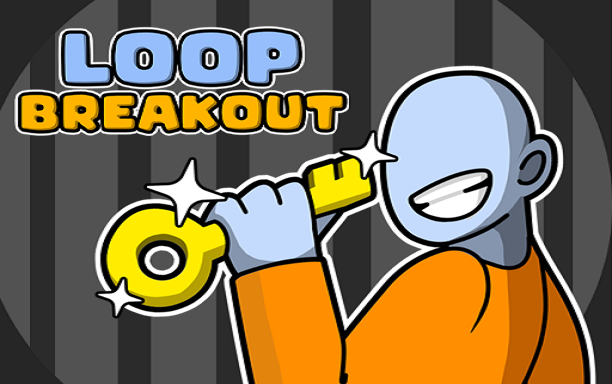
Survey the full room before moving — the most productive first action in any new Loop Breakout room is standing still and identifying the key's location, the spike placements, and the available path between them. Players who start moving immediately react to obstacles as they appear; players who survey first make planned decisions.
Jump timing is the game's primary skill — most spike contacts in Loop Breakout happen because a jump was initiated fractionally too early or too late. Develop your jump input timing by focusing on the obstacle's position relative to your character's current position at the moment of input, not the moment it looks like you should jump.
Use the Skip option without guilt — the Help menu Skip exists for rooms that are genuinely disproportionate to your current ability. Using it to continue your progress and return to the skipped room later — when your skills have developed — is a legitimate strategy, not a failure. Loop Breakout has 180 rooms; maintaining momentum through the game is more valuable than stalling on one.
Loop Breakout
Play Loop Breakout online free at racing-limits.io. Jump into instant browser gameplay with no downloads.
Loop Breakout is a precision platformer with a clear narrative premise and an almost overwhelming amount of content: 180 levels of escalating obstacle challenges, each one a room in a prison that your character is determined to escape. The premise is simple — find the hidden key in each room, survive the traps between you and it, and progress through the next door toward freedom. The execution of that premise across 180 increasingly devious rooms is anything but.
The game earns its level count by continuously introducing new obstacle configurations and trap types that prevent any single approach from becoming automatic. Each room is a puzzle as much as a reflex challenge — understanding the obstacle layout, identifying the key's location, and planning a route through the hazards before committing to movement separates efficient players from those who repeatedly trigger the same spikes on instinct-driven approaches. Touching a spike costs a life and restarts the current room, which means rooms can be replayed many times before a clean completion — a repetition structure that functions more like puzzle-solving iteration than frustrating failure.
The 180-level scope gives Loop Breakout a commitment and replayability that shorter platformers can't match. The Skip option — accessible through the Help menu — provides an honest pressure valve for rooms that genuinely exceed a player's current ability, allowing progression through the broader escape narrative without getting permanently stuck on a single challenge. That option, combined with the progressive difficulty structure, makes Loop Breakout accessible to a wide range of platformer skill levels while still providing a ceiling of difficulty that experienced players will take real effort to reach. Escaping this prison is a genuine achievement — 180 rooms worth of evidence that you can.
Key Details:
Genre:
Precision Platformer / Puzzle
Difficulty Level:
Easy start, Very Hard in later levels
Average Play Time:
15–30 minutes per session
Best For:
Platformer fans who enjoy progressive puzzle-solving, reflex challenges, and content-rich games with clear goal structures
How to Play Loop Breakout?
Getting Started:
Enter the first room — observe the layout and locate the hidden key before attempting to move toward it.
Use A/D or Left/Right Arrow keys to move your character through the room.
Press W or the Up Arrow to jump over obstacles, gaps, and hazards between your character and the key.
Reach and collect the key to unlock the door to the next room — then proceed to the next level.
If you touch a spike, you lose a life and restart from the beginning of the current room. Plan your route before committing to movement.
Basic Controls:
Key
Action
A / Left Arrow
Move Left
D / Right Arrow
Move Right
W / Up Arrow
Jump
Esc
Pause Game
? (Help)
Access Skip option for current level
Objective: Escape prison by completing all 180 rooms. In each room, find the hidden key, navigate through the obstacle configuration between you and it, and reach the exit door. Avoid spikes and other hazards — contact costs a life and restarts the room. Use the Skip option when a room is genuinely beyond your current ability.
Loop Breakout Game Features & Highlights
180 levels of progressive difficulty — one of the largest level counts in the browser precision platformer genre, with planned future additions
Hidden key mechanic — each room requires finding and reaching a concealed key before the exit door can be opened
Continuously introducing obstacles — each room's configuration is distinct, preventing any single approach from becoming repetitive across the game's full length
Skip option via Help menu — an honest pressure valve that allows progression past genuinely overwhelming rooms without abandoning the game
Life system with room restart — spike contact costs a life and restarts the current room, creating a retry loop that functions as puzzle iteration
Loop Breakout Tips & Strategies
Beginner Tips:
Survey the full room before moving — the most productive first action in any new Loop Breakout room is standing still and identifying the key's location, the spike placements, and the available path between them. Players who start moving immediately react to obstacles as they appear; players who survey first make planned decisions.
Jump timing is the game's primary skill — most spike contacts in Loop Breakout happen because a jump was initiated fractionally too early or too late. Develop your jump input timing by focusing on the obstacle's position relative to your character's current position at the moment of input, not the moment it looks like you should jump.
Use the Skip option without guilt — the Help menu Skip exists for rooms that are genuinely disproportionate to your current ability. Using it to continue your progress and return to the skipped room later — when your skills have developed — is a legitimate strategy, not a failure. Loop Breakout has 180 rooms; maintaining momentum through the game is more valuable than stalling on one.
Advanced Strategies:
Identify the spike pattern, not just the spike — many rooms in Loop Breakout have spike timing that is synchronized with a rhythm — spikes that move or deploy periodically. Identifying this rhythm before attempting the room lets you move in sync with safe windows rather than reacting to spikes that have already triggered.
Route planning includes the return path — in rooms where the key is positioned such that collecting it changes your position significantly, plan your post-key route to the exit before going for the key. Being surprised by the exit's position after collecting the key is a common source of unnecessary spike contacts in mid-difficulty rooms.
Memorize the first obstacle sequence — on rooms where you're retrying multiple times, the early obstacles become familiar before the later ones do. Treat your retries as progressive learning: each attempt extends your reliable completion further into the room until the full path is mapped.
What to Watch Out For:
Spike placements near the key — the game deliberately positions keys near the most dangerous obstacle configurations in many rooms. Reaching the key successfully doesn't mean the room is solved — the path from key to exit often involves navigating the same or similar hazards from a different position with potentially different momentum.
Jump height variation — Loop Breakout's jump height may vary slightly depending on how long the jump key is held. Rooms that require precise clearance height — clearing a spike but not hitting a ceiling obstacle — reward players who've learned to modulate their jump duration, not just their jump timing.
Loop Breakout Game Elements Explained
Key & Door System: The key-and-door structure is Loop Breakout's primary progression mechanic and the element that distinguishes it from a standard obstacle runner. Each room contains one hidden key that must be collected before the exit door will open — the door is visible but inaccessible until the key is retrieved. This two-objective design changes how each room is approached: rather than a single straight-line challenge from entrance to exit, every room requires solving two spatial puzzles — the path to the key and the path from the key to the door. The key's placement varies across rooms from relatively accessible positions that reward the player's confidence with a clean pickup to deliberately provocative placements that are surrounded by the room's most dangerous obstacles. The placement choice signals the room's overall difficulty more clearly than any difficulty rating: a key placed in a clear area suggests that the challenge is the path to the door; a key surrounded by spikes indicates that collection itself is the primary challenge.
Obstacle System: Loop Breakout's 180 rooms maintain variety across their full length by continuously introducing new obstacle type combinations rather than repeating familiar configurations in larger quantities. Early rooms use single spike types in straightforward patterns that teach the game's basic movement physics. Mid-game rooms layer multiple obstacle types with timing-dependent safe windows that require reading patterns rather than reacting to individual hazards. Late-game rooms combine moving obstacles, precise jump height requirements, and compressed safe windows into configurations that can genuinely require many attempts to understand before they become executable. The spike — the game's most consistent and prominent hazard — appears in every room but in configurations that range from obvious to deliberately deceptive. Spikes placed in positions where they're partially obscured by the room's architecture, or positioned to look like safe ground, are the game's most demanding design choices.
Level Structure & Skip System: The 180-level structure in Loop Breakout is organized as a progressive difficulty curve that introduces new obstacle configurations incrementally across its full length. The skip option — accessible through the Help (?) menu — allows players to advance past any room they choose without completing it, continuing the prison escape narrative without being permanently blocked by a single room. This design choice reflects an understanding that a 180-level platformer's primary enemy is player abandonment through frustration — a player who skips three rooms and continues to level 100 is a more engaged player than one who stops at level 37 because a single room refused to yield. The skip system doesn't remove the challenge or cheapen completion: the game tracks which rooms were completed naturally versus skipped, and players who want the full experience can return to skipped rooms after developing the skills that the later, more varied rooms build.
Loop Breakout Frequently Asked Questions
Q: How do I find the key in each room? A: The key is hidden within each room's layout — it appears as a collectible item that your character must physically reach and touch to collect. Survey the full room from your starting position before moving — the key is often visible from the entrance but positioned in a location that requires navigating the room's full obstacle layout to reach.
Q: What should I do if I keep touching the same spike? A: Stop moving and identify exactly where your jump is going wrong relative to the spike's position. Is the jump too early (you haven't built enough horizontal clearance before the jump)? Too late (you're already at the spike's position when the jump starts)? Too high or too low (you're clearing the spike's height but hitting a ceiling, or not clearing the spike at all)? Diagnosing the specific error type makes the correction deliberate rather than random.
Q: Is there a limit to how many rooms I can skip? A: The Skip option in the Help menu allows you to bypass any room without a fixed limit on how many rooms can be skipped in a session. Using it freely to maintain progress through the game is a legitimate approach, particularly in a 180-level game where some rooms are disproportionately harder than their surrounding levels.
Q: Is Loop Breakout compatible with mobile devices? A: Loop Breakout uses keyboard controls (WASD and arrow keys) and is best suited for desktop and laptop browsers. Mobile play requires a connected external keyboard for reliable movement and jump inputs.
Q: How many levels does Loop Breakout have? A: Loop Breakout currently features 180 levels, with additional levels planned for future updates. The difficulty curve progresses consistently across all 180 rooms, with later levels introducing obstacle configurations that are meaningfully more demanding than anything in the first third of the game.
Related Games Like Loop Breakout You Might Enjoy
If you like Loop Breakout, you might also enjoy:
Atari Breakout - It shares similar browser-game pacing and gives you another quick challenge to master.
Loop Crash - It shares similar browser-game pacing and gives you another quick challenge to master.
Black Holeio - It is another easy-to-start browser game with strong replay value.

 Drift Frenzy
 Drift Rush
 Arcade Glide
 Track Dash
 Retro Rush
 Escape Road 3
 Wave Rider
 Traffic Road
 Escape Road City 2
 Bike Xtreme
 Escape Road 2
 Traffic Rally
 Tap Drift
 Drive Mad
 Wheelie Master
 Wheelie Party
 Moto X3M
 Street Wheelie
 Car Chaos
 Escape Drive
 Blocky Rider
 Mad Pursuit
 Mad Racers
 Chase Rush
 Smashy Road
 Driftio
 Night City Racing
 Hill Climb Racing
 Drift Hunters
 Smash Karts
 GT Cars Mega Ramps
 Motorcycle Racer Road Mayhem
 Funny Mad Racing