Select your board or jet ski from the available roster and launch into the ocean.
Your board moves forward automatically — use directional controls to steer left, right, or adjust your position.
Watch for obstacles appearing ahead and steer early to avoid them — late reactions lead to collisions.
High Score Tips
Keep your steering inputs smooth and gradual — sharp corrections at speed often overcorrect you into the obstacle you were trying to avoid.
Scan further ahead than feels natural; at higher speeds, obstacles you see at medium distance are already nearly upon you.
Accept that starfish near the edges of the course aren't worth it early on — a safe central riding line is more valuable than peripheral pickups.
Wave Rider
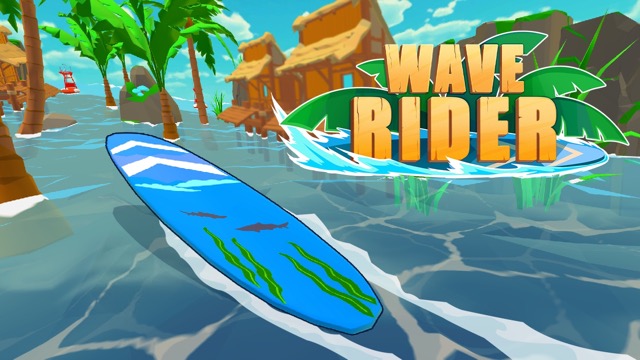
Play Wave Rider online free at racing-limits.io. Wave Rider is a sun-soaked endless runner set on the open ocean, where you trade asphalt for waves and car horns for crashing surf.
Wave Rider is a sun-soaked endless runner set on the open ocean, where you trade asphalt for waves and car horns for crashing surf. The concept is simple and immediately appealing: ride a surfboard or jet ski across rolling ocean water, dodge a relentless stream of obstacles, and see how far you can push before the course finally catches up with you.
The game captures a genuine summer energy — vibrant colors, breezy momentum, and the kind of chill visual style that makes it feel like the right game for a quick break, even as the gameplay itself gets progressively less relaxing as your run extends. Obstacles range from floating logs and rocks to holes in the water surface, waterfalls, and other environmental hazards that force quick read-and-react decisions. Your reflexes and timing are the only tools you have, and the game tests both consistently.
Starfish collected during runs function as the in-game currency for unlocking new boards and jet skis, giving the roster-building loop a satisfying material feel — you're literally gathering things from the ocean to earn gear. The roster itself spans a variety of visual styles, from classic surfboards to motorized options that change the aesthetic of your run without altering the core mechanics.
Wave Rider doesn't try to be a deep systems game. It's an accessible, visually cheerful endless runner with clean controls and a satisfying difficulty curve — the kind of game that earns its reputation as a perfect casual session filler. Easy to start, hard to master, and impossible to fully put down.
Key Details:
Genre
Endless Runner / Casual Arcade
Difficulty Level
Easy start, progressively Hard
Average Play Time
3–10 minutes per run
Best For
Casual players looking for a relaxed-vibe arcade game with a genuine skill ceiling
How to Play Wave Rider?
Getting Started:
Select your board or jet ski from the available roster and launch into the ocean.
Your board moves forward automatically — use directional controls to steer left, right, or adjust your position.
Watch for obstacles appearing ahead and steer early to avoid them — late reactions lead to collisions.
Collect starfish as you go to fund future board unlocks, but never prioritize them over obstacle avoidance.
Adjust your reflexes as speed increases — the same obstacles demand faster reads later in your run.
Basic Controls:
W / Up Arrow — Move forward / adjust pace
A / Left Arrow — Steer left
D / Right Arrow — Steer right
Objective: Ride as far as possible without colliding with any obstacle. Collect starfish during your run to unlock new boards and jet skis. Any collision ends your run immediately with no revival option.
Wave Rider Game Features & Highlights
Vibrant summer aesthetic with colorful ocean visuals and a breezy tone that's immediately inviting
Diverse obstacle types — logs, rocks, holes, waterfalls, and more — that keep the course unpredictable
Starfish collection system that ties run performance directly to long-term board unlocks
Multiple boards and jet skis with distinct visual styles to customize your ride
Escalating pace that transforms an accessible opener into a genuine reflex test over longer runs
Wave Rider Tips & Strategies
Beginner Tips:
Keep your steering inputs smooth and gradual — sharp corrections at speed often overcorrect you into the obstacle you were trying to avoid.
Scan further ahead than feels natural; at higher speeds, obstacles you see at medium distance are already nearly upon you.
Accept that starfish near the edges of the course aren't worth it early on — a safe central riding line is more valuable than peripheral pickups.
Advanced Strategies:
Develop a mental hazard hierarchy: holes and waterfalls are the highest-priority obstacles (no safe half-contact), while logs and rocks can sometimes be grazed if your angle is right. Triage accordingly.
Use brief moments of clear ocean to re-center your board's position — don't let repeated minor corrections push you toward the course edges where obstacles cluster.
At maximum speed, switch from reactive to anticipatory steering: commit to a path a half-second ahead of each obstacle cluster rather than responding when it's directly in front of you.
What to Watch Out For:
Starfish distraction is the most common early-run mistake. A starfish positioned just off your safe line is the game baiting you into a collision. If reaching it requires meaningful steering, leave it.
Speed blindness in longer runs — as your board accelerates, distances compress visually and obstacles arrive faster than they look. Recalibrate your lead time continuously rather than applying the same timing you used at the start.
Wave Rider Game Elements Explained
The Obstacle System
Wave Rider's obstacle variety is designed to test different types of spatial awareness. Static obstacles — rocks, logs — require path-reading and early steering. Holes in the water surface punish any contact and are particularly tricky because they blend into the wave texture at speed. Waterfalls create vertical environmental hazards that interrupt the normally lateral obstacle language of the game, requiring a moment of full attention before navigating through or around them. As your run extends, the density and combination of these obstacle types increases: solo objects give way to multi-obstacle clusters where clearing one element immediately exposes the next. The strategic implication is that surviving long runs isn't about handling any one obstacle type in isolation — it's about reading composite formations and finding the cleanest path through them as a unit. The game rewards players who develop this holistic track-reading habit over those who react to obstacles individually.
The Starfish & Board Unlock System
Starfish in Wave Rider function as both a collectible challenge and a currency system. During each run, they appear scattered across the course — some sitting cleanly on your natural riding line, others positioned off to the side or near obstacle clusters. The in-line ones are essentially free; the off-line ones require a judgment call. Over time, starfish accumulate into the unlock currency for the game's board and jet ski roster, which spans enough visual variety to give long-term players meaningful milestones to pursue. The strategic dimension of the system is knowing when a starfish is genuinely low-risk versus when the game is using it as obstacle bait. A starfish flanked by rocks or sitting at the edge of the playable zone is almost always a trap. Developing the ability to instantly categorize "safe pickup" versus "risky detour" is a surprisingly significant skill that extends average run lengths once mastered.
The Speed Escalation System
Wave Rider's difficulty is delivered almost entirely through speed. Your board doesn't encounter mechanically new obstacles as your run progresses — it encounters the same obstacles arriving faster and with less reaction time between them. This escalation structure has an important implication for how you develop as a player: the techniques that work at low speed (reactive steering, close-range reads) break down progressively as the game accelerates. Players who don't adapt their timing — shifting from reactive to anticipatory, reading further ahead, committing to paths earlier — will consistently hit a ceiling at a particular run length that feels like the game's maximum difficulty but is actually just the limit of their current approach. Breaking through that ceiling requires consciously lengthening your visual horizon and pre-committing to steering decisions before you'd naturally feel ready. The game never tells you to do this; it just stops rewarding you until you figure it out.
Wave Rider Frequently Asked Questions
Q: How do I control my board in Wave Rider? A: Use the W/A/D keys or the arrow keys to steer your surfboard or jet ski. W controls forward movement, while A and D steer left and right respectively. The board moves forward automatically, so most of your inputs will be lateral steering adjustments.
Q: What should I do if I keep crashing on the same obstacle type? A: Identify whether the issue is reaction time (you see it but can't respond fast enough) or recognition (you're not reading it early enough). For reaction issues, steer earlier before obstacles feel urgent. For recognition issues, practice scanning further ahead rather than focusing directly in front of your board.
Q: Is Wave Rider compatible with mobile devices? A: Wave Rider's keyboard-based controls (W/A/D or arrow keys) are optimized for desktop and laptop play. Mobile browser compatibility may vary; desktop is recommended for the most reliable control experience.
Q: Can I save my progress and starfish count? A: Yes. Starfish totals, board unlocks, and personal best distances are saved automatically between sessions, so your collection and records carry over each time you return to the game.
Q: How do I unlock new boards and jet skis? A: Collect starfish during your runs — they function as the in-game currency for board unlocks. Access the board selection menu to see each item's starfish cost and track your progress toward the ones you're targeting. Consistent collection across multiple runs, even shorter ones, builds your total steadily over time.
Related Games Like Wave Rider You Might Enjoy
If you like Wave Rider, you might also enjoy:
Jetski Race - It keeps the action on water with fast movement, obstacles, and aquatic racing energy.
Ski Frenzy - It offers another bright endless-runner challenge built around reflexes and pickups.
Snow Road 3D - It swaps ocean waves for snowy slopes while keeping the same dodge-and-survive rhythm.

 Drift Frenzy
 Drift Rush
 Arcade Glide
 Track Dash
 Retro Rush
 Escape Road 3
 Wave Rider
 Traffic Road
 Escape Road City 2
 Bike Xtreme
 Escape Road 2
 Traffic Rally
 Tap Drift
 Drive Mad
 Wheelie Master
 Wheelie Party
 Moto X3M
 Street Wheelie
 Car Chaos
 Escape Drive
 Blocky Rider
 Mad Pursuit
 Mad Racers
 Chase Rush
 Smashy Road
 Driftio
 Night City Racing
 Hill Climb Racing
 Drift Hunters
 Smash Karts
 GT Cars Mega Ramps
 Motorcycle Racer Road Mayhem
 Funny Mad Racing