Start with City mode to learn bike handling without pressure — City mode removes crash consequences and time limits, providing a safe environment to calibrate each bike's steering responsiveness, braking distance, and acceleration behavior before applying those instincts in Race or Demolition mode.
In Race mode, maintain speed rather than maximizing it — maximum acceleration in dense traffic creates more reaction time problems than it solves. Find the speed at which traffic feels manageable and hold it consistently rather than accelerating to maximum and then braking in emergencies.
In Demolition mode, prioritize mobile target types — stationary obstacles produce points but require precise impact angles; moving vehicles can be intercepted at various angles and provide more scoring opportunities per unit of time. Learn the traffic pattern and target moving vehicles that cross your path rather than chasing specific static targets.
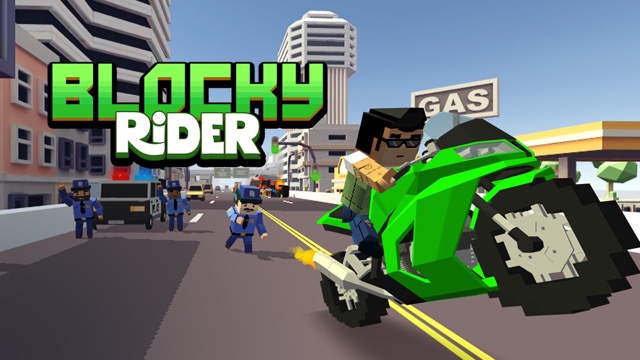
Blocky Rider
Play Blocky Rider online free at racing-limits.io. Jump into instant browser gameplay with no downloads.
Blocky Rider is a block-style 3D motorcycle game that makes the clever decision to present three completely different games within one package. Race mode is a survival challenge — weave through traffic, hold your speed, stay alive as long as possible. Demolition mode inverts the entire premise — stop dodging and start hitting, smashing into as many vehicles as possible within a time limit for points. City mode drops all pressure entirely — explore the blocky city streets at your own pace, practice your bike control, enjoy the environment. Three modes, three motivations, three experiences from one motorcycle game.
The no-upgrades, no-boosts design philosophy is the game's most deliberate choice and its most clarifying one. Your success in Race and Demolition mode is entirely dependent on your riding skill — nothing else is in play. No speed boost to compensate for poor lane discipline; no extra health to absorb the collision you should have avoided; no passive income making your runs longer than your skill deserves. Blocky Rider has the confidence to say that the only variable separating good runs from bad ones is the rider, and it commits to that design fully.
The three unlockable bikes — Cross, Superbike, and Police bike — each bring a different handling personality to the same city environment, providing variety across the game's modes without introducing power progression. Which bike handles best is a personal skill compatibility question rather than a universal answer, and the game benefits from that design: players spend time with all three bikes rather than identifying the "best" one and ignoring the others.
Key Details:
Genre:
Motorcycle Racing / Skill Game
Difficulty Level:
Medium (Race), Easy (City), Variable (Demolition)
Average Play Time:
10–20 minutes per session
Best For:
Players who enjoy skill-pure motorcycle games, three-mode variety, and the specific satisfaction of pure survival distance without power-up assistance
How to Play Blocky Rider?
Getting Started:
Select your bike — Cross, Superbike, or Police bike — each with distinct handling feel.
Choose your mode: Race (survival distance), Demolition (timed smash scoring), or City (free exploration).
On PC, use W/Up Arrow to accelerate, S/Down Arrow to brake, A/D or Left/Right to steer. Press C to change camera view.
On mobile, use the on-screen arrows for all movement and direction.
Adjust your goal to the mode: in Race, avoid everything; in Demolition, hit everything; in City, do whatever you want.
Basic Controls:
Key
Action
W / Up Arrow
Accelerate
S / Down Arrow
Brake
A / Left Arrow
Steer Left
D / Right Arrow
Steer Right
C
Change camera view
On-screen arrows
Mobile movement controls
Objective: Mode-dependent — survive as long as possible in Race; score maximum smash points in Demolition's time limit; explore freely in City. No upgrades, boosts, or power-ups exist across any mode — pure skill determines all outcomes.
Blocky Rider Game Features & Highlights
Three distinct modes — Race (survival), Demolition (timed smash scoring), and City (free exploration) each with fundamentally different objectives
Skill-pure design — no upgrades, boosts, or power-ups; rider skill is the only performance variable in all modes
Three unlockable bikes — Cross, Superbike, and Police bike with distinct handling personalities
Block-style 3D graphics — distinctive visual aesthetic in a detailed city environment
Camera view switching — C key allows perspective changes that suit different riding styles and mode preferences
Blocky Rider Tips & Strategies
Beginner Tips:
Start with City mode to learn bike handling without pressure — City mode removes crash consequences and time limits, providing a safe environment to calibrate each bike's steering responsiveness, braking distance, and acceleration behavior before applying those instincts in Race or Demolition mode.
In Race mode, maintain speed rather than maximizing it — maximum acceleration in dense traffic creates more reaction time problems than it solves. Find the speed at which traffic feels manageable and hold it consistently rather than accelerating to maximum and then braking in emergencies.
In Demolition mode, prioritize mobile target types — stationary obstacles produce points but require precise impact angles; moving vehicles can be intercepted at various angles and provide more scoring opportunities per unit of time. Learn the traffic pattern and target moving vehicles that cross your path rather than chasing specific static targets.
Advanced Strategies:
Develop the "cover brake" habit in Race mode — the most dangerous moment in Race mode traffic is a vehicle changing lanes unexpectedly. Having your braking input ready (finger near S/Down Arrow) rather than fully committed to acceleration means your reaction time to unexpected lane changes is one input rather than two. Cover the brake during dense traffic sections.
Camera view selection affects your effective reaction distance — the C key cycles through camera perspectives. A close-following camera provides better lateral traffic awareness; a higher or more distant camera provides more forward visibility for upcoming obstacles. Match your camera to the traffic density you're currently navigating — closer views for dense traffic; more distant views for open stretches.
In Demolition mode, use the timer to select impact efficiency — with a fixed time limit, the highest scores come from high-value impacts delivered efficiently. A small motorcycle-sized vehicle hit is worth fewer points than a large truck hit. Identify large vehicle targets and route toward them rather than hitting the first available vehicle regardless of size.
What to Watch Out For:
Unexpected lane changes in Race mode — traffic vehicles change lanes without warning, and at the speeds Race mode rewards, unexpected lane changes are the most common cause of crashes. Maintain a spatial buffer around your bike that allows one-lane evasion in either direction rather than positioning flush against adjacent vehicles.
The skill gap between bikes in Race mode — different bikes have different handling responses to the same input. The Superbike's higher speed requires earlier braking; the Cross bike's different weight distribution affects lane-change responsiveness. Switching bikes mid-progression without recalibrating to the new bike's feel is a common source of early crashes on an unfamiliar model.
Blocky Rider Game Elements Explained
Three-Mode Structure: The three game modes in Blocky Rider aren't variations on a single theme — they're genuinely different games using the same city environment and motorcycle controls. Race mode creates a survival experience where the objective is continuous existence: dodge traffic, manage speed, extend the run indefinitely against increasing statistical difficulty. The skills it develops — lane reading, speed management, emergency braking — are defensive and reactive. Demolition mode creates an entirely different relationship with the same traffic: instead of avoiding collisions, you're engineering them, which develops offensive positioning skills and impact timing awareness that Race mode never asks for. City mode removes all competitive structure, converting the game into a practice environment and exploration experience. The three-mode design means Blocky Rider provides something genuinely different depending on what you want from a motorcycle game session.
Skill-Pure Design Philosophy: The absence of upgrades, boosts, and power-ups in Blocky Rider is a foundational design choice that changes how performance improvement feels. In upgrade-based motorcycle games, a longer run might reflect better equipment as much as better riding. In Blocky Rider, a longer Race mode run or a higher Demolition mode score is a direct and unambiguous reflection of improved riding skill. This purity creates a cleaner feedback loop between practice and result: when you crash, the specific input that produced the crash is identifiable; when you improve, the improvement is attributable to a specific riding habit that developed correctly. For players who want to know whether they're actually getting better rather than just better-equipped, Blocky Rider's skill-pure design provides that clarity.
Bike Selection System: The three bikes in Blocky Rider — Cross, Superbike, and Police bike — each have distinct handling personalities that create different riding experiences across the same modes. The Cross bike's off-road-style geometry typically produces different balance characteristics from the Superbike's speed-oriented profile; the Police bike brings its own weight and response characteristics distinct from both. These differences are handling differences rather than performance tier differences — no single bike is universally "best." The Cross bike may suit players who prefer deliberate, stable steering; the Superbike may suit players who prefer high-speed, responsive handling; the Police bike may suit players with specific control preferences that the other two don't match. Unlocking all three and developing fluency with each produces a more complete understanding of Blocky Rider's handling system than committing exclusively to one.
Blocky Rider Frequently Asked Questions
Q: What are the three game modes in Blocky Rider? A: Race mode — survive as long as possible by weaving through traffic and avoiding crashes for maximum distance. Demolition mode — smash into other vehicles deliberately to score points before the timer expires. City mode — explore the city freely with no crashes, time limits, or objectives. Each mode has a completely different goal and playstyle.
Q: Does Blocky Rider have upgrades or power-ups? A: No — Blocky Rider has no upgrades, boosts, or power-ups in any mode. Your riding skill is the only performance variable. This applies to all three bikes across all three modes.
Q: Which bike should I start with in Blocky Rider? A: Start with whichever bike is immediately available and spend time in City mode calibrating its specific handling — steering responsiveness, braking distance, acceleration feel. Once you have a baseline for one bike, unlock and compare the others. The "best" bike varies by personal control preferences rather than universal performance rankings.
Q: Is Blocky Rider compatible with mobile devices? A: Yes — Blocky Rider provides on-screen arrow controls for mobile touchscreen play. Use the on-screen arrows for acceleration, braking, and steering in place of the WASD/arrow keyboard controls. The game is fully playable on mobile browsers.
Q: How do I change the camera view in Blocky Rider? A: Press the C key to cycle through available camera perspectives. Different views provide different balances of lateral traffic awareness and forward visibility — experiment with each to find the view that best suits your riding style and the mode you're currently playing.
Related Games Like Blocky Rider You Might Enjoy
If you like Blocky Rider, you might also enjoy:
Blocky Overtake X - It offers a related skill loop where timing, planning, or steady improvement matters.
Tilemanio - It offers a related skill loop where timing, planning, or steady improvement matters.
Geoguessr - It offers a related skill loop where timing, planning, or steady improvement matters.
 Drift Frenzy
 Drift Rush
 Arcade Glide
 Track Dash
 Retro Rush
 Escape Road 3
 Wave Rider
 Traffic Road
 Escape Road City 2
 Bike Xtreme
 Escape Road 2
 Traffic Rally
 Tap Drift
 Drive Mad
 Wheelie Master
 Wheelie Party
 Moto X3M
 Street Wheelie
 Car Chaos
 Escape Drive
 Blocky Rider
 Mad Pursuit
 Mad Racers
 Chase Rush
 Smashy Road
 Driftio
 Night City Racing
 Hill Climb Racing
 Drift Hunters
 Smash Karts
 GT Cars Mega Ramps
 Motorcycle Racer Road Mayhem
 Funny Mad Racing