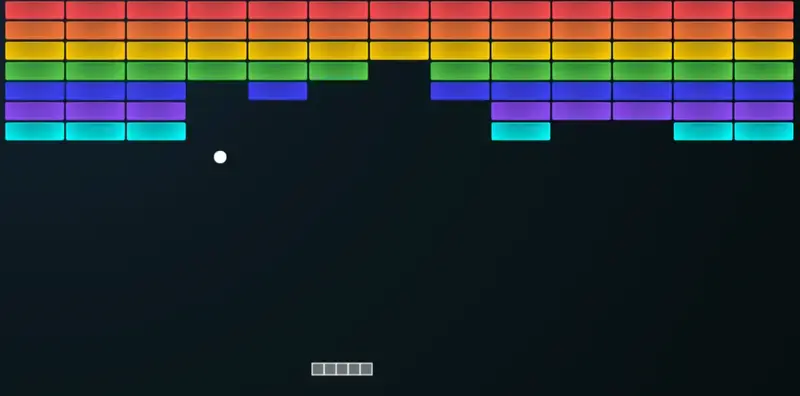
Move the paddle to the ball, don't wait for the ball to come to you — the most common beginner mistake in Breakout is tracking the ball's horizontal position passively and reacting at the last moment. Move the paddle proactively toward where the ball is going to land, which gives you time to fine-tune your position for the angle you want.
Aim for the edges of the brick wall to clear angles earlier — breaking bricks at the sides of the formation allows the ball to travel through cleared channels to reach higher bricks more quickly. Working systematically from one edge inward creates the clearest path to the top rows.
Don't panic in the upper section — when the ball is bouncing in the cleared upper portion of the screen with only a few bricks remaining, its angles become harder to predict. Slow down your mental pace, watch the ball carefully, and make deliberate paddle movements rather than reactive sweeps.
Atari Breakout
Play Atari Breakout online free at racing-limits.io. Jump into instant browser gameplay with no downloads.
Atari Breakout is one of gaming's foundational classics — a brick-breaking game so elegantly designed that its core concept has never needed replacement, only refinement. A paddle at the bottom. A ball bouncing between the paddle and the brick wall above. Three lives. The goal: destroy every brick on screen. The challenge: keeping the ball in play long enough to do it, at speeds and angles that increase with every level cleared.
The game's physics are its most carefully considered element. The ball doesn't bounce randomly — its angle off the paddle is determined by where exactly on the paddle it makes contact. Hitting with the left side sends the ball left; hitting with the right side sends it right; hitting the center continues its current angle. This paddle-angle relationship is the game's primary skill mechanism, giving players genuine control over where the ball goes if they're willing to move the paddle to meet it at the right position rather than simply tracking underneath it.
What makes Atari Breakout endure across decades is the experience arc of each life. A ball freshly served is manageable — the bricks are intact, the ball is moving at moderate speed, and every bounce is predictable. But as bricks disappear and the ball begins bouncing at odd angles in the empty upper portions of the screen, the game's pace and unpredictability increase significantly. The best Breakout sessions have this natural escalation built in: you start in control, and the game patiently extracts that control from you until you either clear the board or run out of lives. That arc is as satisfying today as when it first appeared.
Key Details:
Genre:
Classic Arcade / Brick Breaker
Difficulty Level:
Easy start, Hard at later levels
Average Play Time:
5–15 minutes per session
Best For:
All ages; fans of classic arcade games, casual players, and anyone who enjoys the satisfying brick-clearing loop
How to Play Atari Breakout?
Getting Started:
Use the Left/Right Arrow keys, A/D keys, or your mouse to move the paddle horizontally beneath the ball.
Keep the ball in play by positioning the paddle under it before it reaches the bottom of the screen.
Let the ball bounce upward to strike bricks — each hit scores points and removes the brick from the wall.
Clear all bricks on the screen to complete the level and advance to the next.
The game ends after the ball falls off the screen three times — use your three lives wisely.
Basic Controls:
Input
Action
Left/Right Arrow
Move paddle left/right
A / D
Move paddle left/right (alternative)
Mouse
Move paddle (follows cursor position)
Objective: Break all bricks on screen by bouncing the ball off the paddle into the brick wall above. Score points for each brick destroyed. Complete each level within three lives — if the ball falls off the screen three times, the game ends.
Atari Breakout Game Features & Highlights
Angle-responsive ball physics — paddle contact position determines ball angle, giving players directional control over where the ball travels
Three-life system — three ball drops end the game, making each life genuinely precious in later levels
Progressive difficulty — paddle shrinkage, ball speed increase, and more complex brick configurations escalate challenge as levels advance
Color-coded brick structure — different brick colors may correspond to different point values or durability, rewarding strategic targeting
Timeless classic format — the original Atari Breakout gameplay experience fully intact in browser format
Atari Breakout Tips & Strategies
Beginner Tips:
Move the paddle to the ball, don't wait for the ball to come to you — the most common beginner mistake in Breakout is tracking the ball's horizontal position passively and reacting at the last moment. Move the paddle proactively toward where the ball is going to land, which gives you time to fine-tune your position for the angle you want.
Aim for the edges of the brick wall to clear angles earlier — breaking bricks at the sides of the formation allows the ball to travel through cleared channels to reach higher bricks more quickly. Working systematically from one edge inward creates the clearest path to the top rows.
Don't panic in the upper section — when the ball is bouncing in the cleared upper portion of the screen with only a few bricks remaining, its angles become harder to predict. Slow down your mental pace, watch the ball carefully, and make deliberate paddle movements rather than reactive sweeps.
Advanced Strategies:
Use the paddle's edge intentionally for angle manipulation — deliberately hitting the ball with the extreme left or right edge of the paddle produces a sharper angle than center hits. Use edge hits to create angled approaches to brick clusters that are hard to reach with center-ball trajectory.
Break through to the top row for a high-score multiplier — reaching the top-most brick row typically provides a bonus score multiplier or dramatically increased points for each subsequent brick hit. Prioritizing a path through the center column to reach the top row early is a high-yield strategy in scoring-focused play.
In multi-durability brick levels, track which bricks need multiple hits — some level configurations include bricks that require two or more hits to break. Identifying and prioritizing these bricks before they block your ball's path to the back wall is more efficient than repeatedly hitting single-durability bricks while the multi-hit ones remain.
What to Watch Out For:
Paddle shrinkage at higher levels — some Breakout implementations reduce paddle width as difficulty increases, making the angular precision of where on the paddle the ball makes contact more challenging to control. Anticipate that the paddle's effective range is narrower than at the start and adjust your positioning accordingly.
Ball speed acceleration — the ball typically speeds up as levels progress and occasionally after a specified number of bricks are broken. A speed jump that happens mid-rally can catch even experienced players off guard if they're not expecting it. Stay aware that the ball may become faster than it currently is at any point in an advanced level.
Atari Breakout Game Elements Explained
Angle-Responsive Ball Physics: The relationship between paddle contact position and ball angle is Atari Breakout's most important mechanical depth element. A ball that hits the center of the paddle continues on its current angle — if it was traveling at 45 degrees left, it leaves the paddle at 45 degrees left. A ball that hits the left portion of the paddle is redirected further left; a ball hitting the right portion is redirected further right. This means that every ball contact with the paddle is an opportunity to steer the ball's direction intentionally rather than simply keeping it in play. Players who understand this system position the paddle to hit the ball at a specific point on its surface rather than anywhere on the paddle — producing controlled trajectories toward target bricks rather than random bounces. This distinction between "keeping the ball alive" and "controlling where the ball goes" is what separates casual Breakout players from skilled ones.
Brick Structure & Color System: Atari Breakout's brick wall is organized in horizontal rows that often correspond to different point values or durability tiers by color. Higher-value bricks are typically positioned in the upper rows — farther from the paddle and therefore harder to reach with consistent ball contact. This value distribution creates an incentive to clear downward rows efficiently (to reach the upper rows) rather than haphazardly, rewarding strategic brick prioritization over random targeting. Multi-durability bricks, which require more than one hit to break, appear in some level configurations and change the tactical priority — a brick requiring three hits represents a sustained commitment that affects which portions of the wall clear first. Understanding the brick structure of each level before settling into a hitting pattern produces more efficient clears than reacting to whatever brick the ball happens to reach.
Three-Life System: The three-life format is the tension-generating mechanism that makes each individual ball drop genuinely consequential. Unlike unlimited-life games where any individual mistake is recoverable, Breakout's three-life limit means that three missed catches — spread across an entire session — end the run regardless of how many bricks have been cleared. This creates a meaningful risk calculus in later levels when brick configurations make the ball's angle increasingly unpredictable: aggressive brick targeting produces more strategic advantage but increases the chance of a difficult-to-read bounce that results in a miss. The three-life economy rewards controlled, systematic play in the early and middle stages of a session, with the remaining lives acting as the resources available for the more difficult brick arrangements that appear when the wall is nearly cleared.
Atari Breakout Frequently Asked Questions
Q: How do I control where the ball goes? A: The ball's angle depends on where on the paddle it makes contact. Hitting with the left portion of the paddle sends the ball left; hitting with the right portion sends it right; hitting the center maintains the current angle. Position the paddle specifically — not just anywhere under the ball — to control the ball's direction after each bounce.
Q: What happens after I lose all three lives? A: The game ends — your score is recorded based on the bricks cleared and points earned before the final ball drop. Restart to begin a new session from the first level with three fresh lives.
Q: Is Atari Breakout compatible with mobile devices? A: Atari Breakout supports mouse-based control that translates to touch-drag on mobile browsers — move your finger horizontally to control the paddle. Arrow key and A/D controls require an external keyboard on mobile.
Q: Why does the ball sometimes speed up unexpectedly? A: Ball speed in Atari Breakout typically increases with level progression and may also increase after a set number of bricks are broken within a level. These speed increases are intentional difficulty escalations — stay mentally alert for potential speed changes rather than settling into a rhythm calibrated to the ball's current pace.
Q: How do I earn the highest scores? A: Focus on reaching the top brick rows as efficiently as possible — higher rows typically provide more points per brick. Clear a vertical channel through lower rows to give the ball direct access to upper rows, where points are highest. Also avoid missing balls by staying focused on paddle positioning throughout each life, since fewer misses means more time accumulating points.
Related Games Like Atari Breakout You Might Enjoy
If you like Atari Breakout, you might also enjoy:
Loop Breakout - It shares similar browser-game pacing and gives you another quick challenge to master.
Black Holeio - It is another easy-to-start browser game with strong replay value.
Wormateio - It is another easy-to-start browser game with strong replay value.

 Drift Frenzy
 Drift Rush
 Arcade Glide
 Track Dash
 Retro Rush
 Escape Road 3
 Wave Rider
 Traffic Road
 Escape Road City 2
 Bike Xtreme
 Escape Road 2
 Traffic Rally
 Tap Drift
 Drive Mad
 Wheelie Master
 Wheelie Party
 Moto X3M
 Street Wheelie
 Car Chaos
 Escape Drive
 Blocky Rider
 Mad Pursuit
 Mad Racers
 Chase Rush
 Smashy Road
 Driftio
 Night City Racing
 Hill Climb Racing
 Drift Hunters
 Smash Karts
 GT Cars Mega Ramps
 Motorcycle Racer Road Mayhem
 Funny Mad Racing