Aim for large same-color clusters when no hook-point is visible — your default targeting should be the largest accessible same-color group on the board. Large clusters clear more bubbles per shot and create more falling-bubble opportunities from sections above the burst.
Use the next bubble preview every single turn — the preview is one of your most valuable tools. If your next bubble color matches a clear hook-point target, you know to prepare that shot without interference from the current bubble. If the preview color doesn't obviously match anything, use the current shot to create match setups for the upcoming color.
Never fire at a single isolated bubble — firing at a lone bubble of a color with no adjacent same-color partners doesn't create a match, adds to the cluster, and descends the cluster without benefit. If no match is available for the current bubble, look for wall-bounce angles that might reach a hidden same-color group rather than firing directly at any accessible but matchless position.
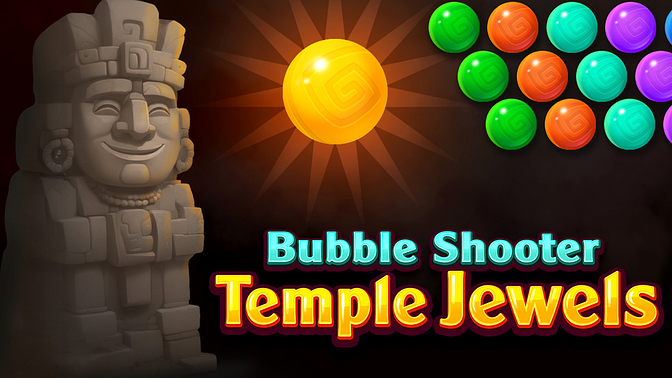
Bubble Shooter Temple Jewels
Play Bubble Shooter Temple Jewels online free at racing-limits.io. Jump into instant browser gameplay with no downloads.
Bubble Shooter Temple Jewels is a bubble-matching game set in the atmospheric world of ancient temples, where jewel-colored bubbles cluster across the screen in formations that reward careful aim and structural thinking over reflexive shooting. The setting isn't cosmetic window dressing — the ancient temple aesthetic creates a visual richness that makes the bubbles, the background, and the shooting experience feel distinctly more immersive than bare-bones bubble shooters. The jewel color palette is vibrant and clear, making color identification immediate and satisfying.
The game delivers the essential bubble shooter experience with clean mechanics: aim, fire, match three or more bubbles of the same color to burst them, and use strategic shot selection to engineer the hanging-bubble drops that clear large sections of the board in single powerful moments. The bubble cluster moves toward the bottom boundary as the game progresses, creating escalating pressure that tests whether your shooting accuracy can keep pace with the descent. Shoot accurately enough and the cluster stays manageable; fire too many unsuccessful shots and the descent accelerates toward the game-ending boundary.
The hook-point strategy is the game's most important tactical concept. Rather than always targeting the largest visible same-color cluster, skilled play recognizes that a small group positioned at the attachment point between the main cluster and a large hanging section represents a high-value target — burst the small attachment group and the entire hanging section falls away for free. This structural thinking converts the game from a pure matching exercise into an architectural puzzle where the cluster's physical structure is as important as its color distribution.
Key Details:
Genre:
Bubble Shooter / Puzzle
Difficulty Level:
Easy start, Medium–Hard at later levels
Average Play Time:
10–20 minutes per session
Best For:
Casual puzzle players, bubble shooter fans, and players who enjoy the ancient temple aesthetic combined with strategic chain-clearing gameplay
How to Play Bubble Shooter Temple Jewels?
Getting Started:
Aim your bubble launcher using your mouse or screen touch — the trajectory line shows where the bubble will travel.
Click or tap to fire the bubble toward the cluster above.
When the fired bubble connects with 3 or more bubbles of the same color, they burst and are cleared from the board.
Any bubbles hanging below the burst group with no remaining attachment to the main cluster fall away automatically.
Observe the next bubble preview to plan your upcoming shot based on what color is coming.
Basic Controls:
Input
Action
Mouse Aim / Screen Touch
Aim the launcher
Click / Tap
Fire bubble
Objective: Clear all bubbles from the screen before the cluster descends past the bottom boundary. Create 3+ same-color matches to burst bubbles, target attachment-point groups to trigger large hanging-bubble drops, and observe the next bubble preview to maintain shot planning continuity.
Bubble Shooter Temple Jewels Game Features & Highlights
Ancient temple visual theme — jewel-colored bubbles set against atmospheric temple architecture create a distinctly immersive puzzle environment
Hook-point targeting strategy — bursting small attachment groups triggers large cascading drops that clear far more bubbles than direct large-cluster targeting
Next bubble preview — upcoming bubble color visible before your current shot, enabling two-step planning
Descent pressure system — the cluster moves toward the bottom boundary as the game progresses, creating urgency that scales with shot accuracy
Progressive level difficulty — more colors, complex cluster layouts, and narrower safety margins increase the challenge across the level progression
Bubble Shooter Temple Jewels Tips & Strategies
Beginner Tips:
Aim for large same-color clusters when no hook-point is visible — your default targeting should be the largest accessible same-color group on the board. Large clusters clear more bubbles per shot and create more falling-bubble opportunities from sections above the burst.
Use the next bubble preview every single turn — the preview is one of your most valuable tools. If your next bubble color matches a clear hook-point target, you know to prepare that shot without interference from the current bubble. If the preview color doesn't obviously match anything, use the current shot to create match setups for the upcoming color.
Never fire at a single isolated bubble — firing at a lone bubble of a color with no adjacent same-color partners doesn't create a match, adds to the cluster, and descends the cluster without benefit. If no match is available for the current bubble, look for wall-bounce angles that might reach a hidden same-color group rather than firing directly at any accessible but matchless position.
Advanced Strategies:
Identify hook points before targeting large clusters — before each shot, spend a moment scanning the cluster for small groups that serve as the only attachment between a large section and the main body. If one exists and matches your current or next bubble, target it ahead of larger obvious clusters — the cascading drop return is far higher per shot.
Bank shots off the side walls for backfield access — clusters that have developed overhangs or curved shapes often have backfield bubbles that aren't directly accessible from the bottom. Angling shots off the side walls to reach these backfield positions is a necessary advanced technique for later-level cluster configurations.
Use the next preview to plan sequential hook-points — if your current bubble can set up a hook-point shot for the next bubble color, executing that setup is often more valuable than a direct but lower-value current match. Two planned shots in sequence can clear far more than two independent shots executed without coordination.
What to Watch Out For:
The cluster's bottom-row proximity — as the cluster descends, the bottom row of bubbles represents the most immediate game-ending threat. When any bubble in the cluster is within dangerous proximity of the bottom boundary, reprioritize to clearing those bottom-row bubbles before continuing hook-point or combo strategies elsewhere on the board.
Shooting without checking the next preview first — firing a bubble before observing the next preview loses the planning advantage that preview provides. A shot that seems fine in isolation may leave a poor setup for the incoming color. Check the preview before aiming, not after.
Bubble Shooter Temple Jewels Game Elements Explained
Hook-Point Architecture Strategy: The hook-point concept is the most distinctive strategic element of Bubble Shooter Temple Jewels. Bubble clusters are not uniform masses — they have structural architecture where some groups serve as connectors between sections (hook points) and other groups are large masses hanging below those connectors. A traditional bubble shooter approach targets the largest visible same-color cluster; the hook-point approach identifies small groups that are the sole attachment for large hanging sections and targets those instead. The mathematical advantage of hook-point targeting is significant: a 3-bubble match at a hook point that drops 20 hanging bubbles produces 23 total clearances from a single shot. The same 3-bubble match at a non-structural position produces 3 clearances plus whatever adjacent matches may cascade. Developing the ability to read the cluster's architecture at a glance — identifying which groups are structural connectors and which are hanging masses — is the skill that most dramatically separates efficient Bubble Shooter Temple Jewels play from standard color-matching play.
Descent & Pressure System: The cluster's descent creates a pressure dynamic that scales with shot accuracy throughout the session. The cluster descends continuously at a pace determined by the game's level settings, and this baseline descent accelerates when shots don't create matches — new bubbles may be added or the descent rate may increase depending on the specific failure mechanic in each level configuration. The result is a pressure curve that begins gently and steepens: early in a level, the cluster is far from the boundary and individual missed shots have low consequence; mid-level, the cluster has descended enough that missed shots begin to feel meaningful; late-level, the cluster's proximity to the boundary makes every shot a high-stakes decision where a misfire's consequence is disproportionate to the opportunity cost of a single shot. This escalating pressure curve keeps the game engaging from start to finish rather than only in crisis moments.
Next Bubble Preview System: The next bubble preview in Bubble Shooter Temple Jewels provides one step of advance planning beyond the current shot. Knowing the color of the upcoming bubble before deciding where to aim the current one transforms each decision from an isolated single-shot choice into a two-shot planning sequence. This planning dimension is what makes the preview one of the game's most valuable tools rather than a minor convenience: a player who ignores the preview makes each shot independently; a player who uses it consistently makes each shot as part of a coordinated pair. Common preview applications include: identifying that the current shot's best use is setting up the incoming color's hook-point opportunity; determining that the current color should be used quickly anywhere to get to a more useful incoming color; and planning ricochet shots that position the current bubble near clusters that the incoming color can then match.
Q: What's the most effective targeting strategy in Bubble Shooter Temple Jewels? A: First, check for hook points — small groups that are the sole attachment between a large hanging section and the main cluster. A 3-bubble match at a hook point can drop 20+ bubbles simultaneously. If no hook point is accessible with your current bubble color, target the largest visible same-color cluster for the most efficient standard match.
Q: What should I do when the cluster gets close to the bottom boundary? A: Reprioritize immediately to clearing the lowest visible bubbles — forget about hook-points, combos, and optimal cluster targeting. Shooting the bubbles closest to the boundary is the only goal when the game-ending condition is near. Survive first, optimize second.
Q: How do I access bubbles behind an overhang or in the cluster's backfield? A: Use wall-bounce shots — aim at the side wall rather than directly at the cluster. The bubble will reflect off the wall and travel toward the cluster from an angle, reaching positions that direct shots can't. The angle of reflection equals the angle of incidence, so aim the shot's approach angle to produce the desired arrival position.
Q: Is Bubble Shooter Temple Jewels compatible with mobile devices? A: Yes — the game uses aim-and-tap controls that translate naturally to touchscreen input. Touch and drag to aim, lift your finger to fire. The game is fully playable on mobile browsers.
Q: How does the next bubble preview help my strategy? A: Check the preview before aiming your current shot — knowing the upcoming color allows you to plan your current shot as a setup for the next one, rather than an isolated decision. If the incoming color matches an important hook-point target, use the current shot to clear the path to it rather than targeting something less strategically valuable.
Related Games Like Bubble Shooter Temple Jewels You Might Enjoy
If you like Bubble Shooter Temple Jewels, you might also enjoy:
Bubble Shooter Ultimate - It matches the action-heavy pace with quick decisions and pressure-filled moments.
Speed Shooter - It matches the action-heavy pace with quick decisions and pressure-filled moments.
Getaway Shootout - It matches the action-heavy pace with quick decisions and pressure-filled moments.

 Drift Frenzy
 Drift Rush
 Arcade Glide
 Track Dash
 Retro Rush
 Escape Road 3
 Wave Rider
 Traffic Road
 Escape Road City 2
 Bike Xtreme
 Escape Road 2
 Traffic Rally
 Tap Drift
 Drive Mad
 Wheelie Master
 Wheelie Party
 Moto X3M
 Street Wheelie
 Car Chaos
 Escape Drive
 Blocky Rider
 Mad Pursuit
 Mad Racers
 Chase Rush
 Smashy Road
 Driftio
 Night City Racing
 Hill Climb Racing
 Drift Hunters
 Smash Karts
 GT Cars Mega Ramps
 Motorcycle Racer Road Mayhem
 Funny Mad Racing