Build momentum before steep sections, not during — a car approaching a steep incline with existing momentum will carry farther than one that tries to build speed on the incline itself. Identify upcoming steep sections while still on flatter terrain and accelerate into them rather than starting from low speed at the base.
A rising nose means too much throttle — when the car's front wheels lift off the ground on a steep grade, that's your warning to ease off the throttle. If the nose continues to rise, a brief brake application can settle it. Waiting until the car is nearly vertical before reacting is too late.
Rough terrain slows you unpredictably — surface irregularities deflect the car's momentum in directions you didn't intend. Accept this unpredictability and maintain enough speed cushion that minor deflections don't stall your momentum completely, while not so much speed that major deflections launch you into a flip.
Mountain Road
Play Mountain Road online free at racing-limits.io. Jump into instant browser gameplay with no downloads.
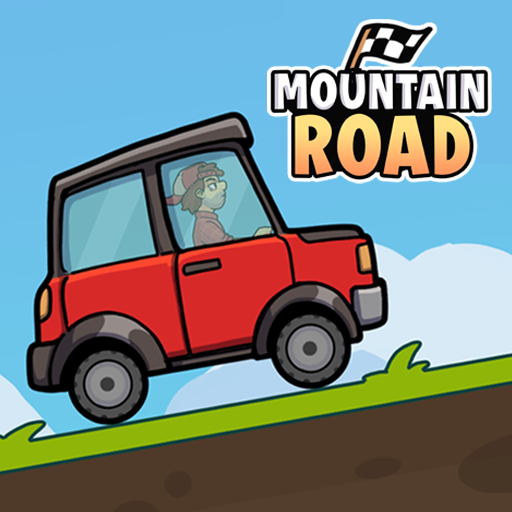
Mountain Road is a hill-climbing driving game that sets one clear objective — reach the highest point — and builds its entire challenge from the terrain between you and that summit. Steep gradients, rough surfaces, and the physics of a car trying to maintain traction and balance against consistent gravity are the game's complete difficulty system. No police, no time limit pressure, no opponents: just you, the car, and the mountain.
The game's appeal is in the combination of simplicity and genuine difficulty. The concept is immediately graspable — drive up the hill — but the execution demands real attention to throttle management, vehicle balance, and terrain reading. Too much speed on a sharp incline and the car pitches backward; too little and it loses momentum on a difficult section. The mountain doesn't negotiate, and the car's physics respond honestly to whatever inputs you provide. This direct relationship between input quality and outcome is what makes mountain driving games satisfying when they go well and genuinely frustrating in the specific way that means you want to try again immediately when they don't.
The rough terrain variety across the climb keeps each section demanding in a slightly different way. Flat sections that let momentum build give way to steep pitches that demand throttle control; those give way to rougher surface patches that deflect trajectory; those eventually give way to whatever the highest point looks like from the summit. Mountain Road is a focused, honest driving challenge without distractions.
Key Details:
Genre:
Hill Climbing / Physics Driving
Difficulty Level:
Medium–Hard
Average Play Time:
10–20 minutes per session
Best For:
Players who enjoy physics-based driving challenges, hill climbing games, and the focused satisfaction of balance and terrain management without competing objectives
How to Play Mountain Road?
Getting Started:
Accelerate to build momentum before steep sections — a running start carries farther on inclines than beginning from near-zero speed.
Manage throttle on steep sections — enough power to maintain momentum without enough to pitch the car backward.
Use braking on downhill transitions or when the car's nose is lifting dangerously high.
Read the terrain ahead to anticipate gradient changes — adjust your speed before a new pitch arrives rather than reacting mid-section.
Reach the highest point to complete the challenge.
Basic Controls:
Input
Action
[Accelerate]
Build speed / Maintain climb momentum
[Brake]
Control descent / Prevent backward flip
[Tilt / Balance]
Adjust vehicle angle on terrain
Objective: Drive your car from the base to the highest point of the mountain, navigating steep hills and rough terrain without flipping or crashing. Manage throttle and balance across the full ascent.
Mountain Road Game Features & Highlights
Mountain terrain challenge — steep gradients, rough surfaces, and elevation changes that demand continuous throttle and balance management
Physics-based driving model — honest vehicle response to inputs and terrain that rewards technique over brute force
Elevation as the objective — reaching the highest point rather than a fixed finish line creates a natural vertical progression goal
Focused single-challenge design — no competing objectives or distractions; pure terrain conquest
Hot driving action — fast-paced enough to feel exciting while demanding enough to require genuine skill
Mountain Road Tips & Strategies
Beginner Tips:
Build momentum before steep sections, not during — a car approaching a steep incline with existing momentum will carry farther than one that tries to build speed on the incline itself. Identify upcoming steep sections while still on flatter terrain and accelerate into them rather than starting from low speed at the base.
A rising nose means too much throttle — when the car's front wheels lift off the ground on a steep grade, that's your warning to ease off the throttle. If the nose continues to rise, a brief brake application can settle it. Waiting until the car is nearly vertical before reacting is too late.
Rough terrain slows you unpredictably — surface irregularities deflect the car's momentum in directions you didn't intend. Accept this unpredictability and maintain enough speed cushion that minor deflections don't stall your momentum completely, while not so much speed that major deflections launch you into a flip.
Advanced Strategies:
Use the throttle in bursts on the steepest grades — continuous full throttle on extreme inclines continuously applies the lifting force that pitches cars backward. Short full-throttle bursts separated by brief ease-offs maintain forward momentum while limiting the sustained lifting force. This burst technique is the most reliable approach to grades that continuous throttle pitches over.
Read rock and bump geometry for trajectory planning — specific rocks and surface features on rough terrain consistently deflect the car in specific directions. Learning which features deflect which way on your most-attempted sections lets you pre-position slightly to use the deflection rather than fight it.
The final approach to the summit typically has the steepest gradient — summit proximity doesn't mean the hardest part is over. Many mountain road games increase gradient severity near the top specifically. Arrive at the final approach with full momentum and manage your throttle conservatively to avoid a backward pitch within sight of completion.
What to Watch Out For:
Momentum loss on rough surface patches mid-incline — a rough section mid-climb reduces your speed at exactly the point where momentum is most needed for the next steep section. Carry slightly more speed than comfortable into rough terrain sections so that the deceleration from surface irregularities leaves you with enough remaining momentum for whatever comes after.
Overcorrection after terrain deflections — when a rock or bump sends the car sideways, the instinct to steer sharply back to center can produce an overcorrection that sends it sideways in the opposite direction. Gentle steering corrections that guide the car back to the intended line are more reliable than aggressive counter-steering that introduces secondary instability.
Mountain Road Game Elements Explained
Terrain & Physics System: Mountain Road's driving challenge is entirely generated by the interaction between the car's physics model and the mountain's terrain geometry. Steep gradients apply gravity force that works against forward momentum and simultaneously applies a pitching torque that lifts the front wheels when engine torque exceeds a threshold. Rough surfaces apply irregular lateral and vertical forces that deflect momentum from the intended direction. The car's physics model responds to both the driver's inputs and these terrain forces simultaneously — the outcome at any point is the sum of throttle force, gravity, terrain contact forces, and the car's own weight distribution. Understanding this multi-force system well enough to predict outcomes before they happen — rather than reacting after the car is already in trouble — is the skill that Mountain Road develops across repeated summit attempts.
Elevation Progression: The highest-point objective gives Mountain Road a natural spatial narrative — you're climbing, and progress is visible as an increase in elevation rather than a distance counter. This vertical orientation creates a specific psychological relationship with the challenge: every section cleared represents literal upward progress that can be felt in the changing view and the increasingly steep terrain profile. Falling short of the summit and having to restart represents a loss of elevation that needs to be re-earned, which makes sustained progress feel particularly valuable. The summit as a fixed visible objective — always up, always requiring more elevation to reach — creates a clarity of purpose that distance-based objectives don't produce in the same way.
Balance Mechanic: The balance between maintaining forward momentum (to continue climbing) and preventing backward pitch (which ends the run) is the game's central physical tension. Momentum is necessary for the car to make progress on steep grades; momentum is also the force that, combined with engine torque, lifts the front wheels when excessive. Every throttle input on a significant gradient is therefore a balance decision: enough power to continue climbing, not so much that the pitch angle exceeds the point where gravity takes the car backward rather than forward. This balance point shifts with gradient angle — a throttle level that's safe on a 30-degree grade may be dangerous on a 60-degree grade. Calibrating to each section's specific balance point is the terrain-reading skill the game continuously demands.
Mountain Road Frequently Asked Questions
Q: How do I stop flipping backward on steep sections? A: Ease off the throttle when the car's nose begins to lift — you'll feel this in the car's visual angle before it becomes critical. If the nose is already significantly raised, a brief, controlled brake application can settle it. Use throttle bursts on extreme grades rather than continuous full power to maintain momentum without the sustained lifting force that causes backward pitches.
Q: What should I do before approaching a steep incline? A: Build momentum on the flat or gentle terrain before the steep section — approach with speed already established rather than trying to build it on the incline itself. The car will carry farther up the grade with existing momentum than it can build from slow speed at the base of a steep pitch.
Q: Why does my car keep getting deflected sideways on rough terrain? A: Rocks and surface irregularities apply lateral forces that redirect momentum. Reduce speed slightly through rough sections to give yourself correction time, and use gentle steering to guide the car back to the intended line after deflections rather than aggressive counter-steering that can overshoot.
Q: Is Mountain Road compatible with mobile devices? A: Mountain Road's hill-climbing controls may support touch input on mobile browsers — check the in-game control options. Desktop keyboard play typically provides the most precise throttle and balance management for the gradient demands the mountain terrain presents.
Q: Does the terrain get steeper near the top? A: Many hill-climbing games increase gradient severity near the summit specifically. Arrive at the final approach with full momentum and apply throttle conservatively — reaching the hardest section of the climb with insufficient speed or with a pitching-prone approach is a common late-stage failure mode.
Related Games Like Mountain Road You Might Enjoy
If you like Mountain Road, you might also enjoy:
Escape Road - It offers another fast road challenge built around awareness and clean reactions.
Snow Road 3D - It offers another fast road challenge built around awareness and clean reactions.
Motorcycle Racer Road Mayhem - It offers another fast road challenge built around awareness and clean reactions.

 Drift Frenzy
 Drift Rush
 Arcade Glide
 Track Dash
 Retro Rush
 Escape Road 3
 Wave Rider
 Traffic Road
 Escape Road City 2
 Bike Xtreme
 Escape Road 2
 Traffic Rally
 Tap Drift
 Drive Mad
 Wheelie Master
 Wheelie Party
 Moto X3M
 Street Wheelie
 Car Chaos
 Escape Drive
 Blocky Rider
 Mad Pursuit
 Mad Racers
 Chase Rush
 Smashy Road
 Driftio
 Night City Racing
 Hill Climb Racing
 Drift Hunters
 Smash Karts
 GT Cars Mega Ramps
 Motorcycle Racer Road Mayhem
 Funny Mad Racing