Scan the full track width, not just the center — in first-person view, hazards approaching in peripheral lanes require attention before they're centered in your view. Train yourself to scan across the full visible track width at each moment rather than watching only the center of your current lane.
Classify obstacles before responding — Subway Moto has two distinct response types: lateral (lane switches for trains and lateral barriers) and vertical (jump for barriers at track level, slide for overhead hazards). Classifying the incoming obstacle's type before responding prevents the wrong input — sliding when you should jump, switching when you should jump over.
Skip money that requires crossing a lane with an oncoming threat — the money collection risk evaluation is explicit in the game's design: collecting scattered currency is valuable but never at the cost of a collision. Any pickup that requires moving into a lane occupied by an oncoming train is a skip, regardless of the collection value.
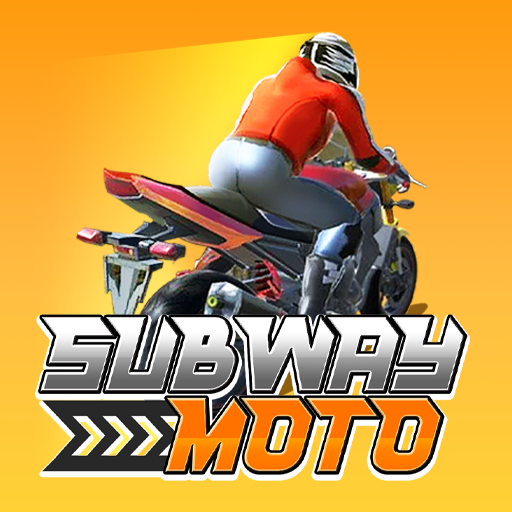
Subway Moto
Play Subway Moto online free at racing-limits.io. Jump into instant browser gameplay with no downloads.
Subway Moto is a first-person motorcycle endless runner set on train tracks — the same core concept as Subway Surfers in its DNA, reskinned for a rider who's looking down a track rather than running along a platform. The obstacles come from both directions: oncoming trains that require lane switches to avoid, and barriers and gaps along the track that require jumps and slides to clear. The track is the world, the first-person view makes the obstacles feel immediate, and the run continues until you collide with something.
The first-person perspective is what makes Subway Moto feel distinctly its own game rather than a standard endless runner. From the rider's eye level, an oncoming train fills the visual field dramatically faster than it would from a top-down or third-person view. Barriers are at your exact height. The track stretches ahead to a vanishing point, and your peripheral field is what gives you warning about incoming hazards before they're directly ahead. This perspective creates genuine tension that a detached camera angle doesn't produce — you're on the track, not watching someone on the track.
Currency collected during runs funds bike unlocks and suit purchases that give each session a persistent purpose beyond the immediate distance score. The suit customization is a rider identity element specific to Subway Moto — you're not just unlocking faster bikes but building the visual identity of the specific rider taking these runs. As the game's difficulty scales with distance, the combination of better bikes and practiced technique produces the progressively longer runs that both the skill development and the unlock economy support.
Key Details:
Genre:
First-Person Motorcycle Endless Runner
Difficulty Level:
Easy start, Hard at extended distances
Average Play Time:
5–15 minutes per run
Best For:
Players who enjoy endless runner games with first-person perspective, lane-switching mechanics, jump-and-slide obstacle management, and motorcycle/rider customization
How to Play Subway Moto?
Getting Started:
The motorcycle moves forward automatically when the run begins — your inputs control direction, jumps, and slides only.
Press A or Left Arrow to switch lanes left; D or Right Arrow to switch lanes right — avoid oncoming trains by moving to clear lanes.
Press W or Up Arrow to jump over barriers and obstacles at track height.
Press S or Down Arrow to slide under overhead obstacles that jumping would hit.
Collect money scattered on the tracks — but skip pickups that put your survival at risk.
Basic Controls:
Key
Action
A / Left Arrow
Switch Lane Left
D / Right Arrow
Switch Lane Right
W / Up Arrow
Jump
S / Down Arrow
Slide
Objective: Travel as far as possible on the train tracks without crashing into obstacles or oncoming trains. Collect money for bike and suit unlocks. The run ends on any collision — one wrong move ends it all.
Subway Moto Game Features & Highlights
First-person perspective — immersive rider's-eye-view that makes obstacles feel immediate and oncoming trains genuinely dramatic
Four-input obstacle system — lane left, lane right, jump, and slide each address distinct obstacle types
Oncoming train lane challenge — train avoidance requires reading which lanes are safe from the approach distance available in first-person view
Money collection with risk evaluation — in-run currency requires real-time assessment of collection risk versus survival priority
Bike and suit unlock system — both vehicle performance and rider visual identity can be developed through earned currency
Subway Moto Tips & Strategies
Beginner Tips:
Scan the full track width, not just the center — in first-person view, hazards approaching in peripheral lanes require attention before they're centered in your view. Train yourself to scan across the full visible track width at each moment rather than watching only the center of your current lane.
Classify obstacles before responding — Subway Moto has two distinct response types: lateral (lane switches for trains and lateral barriers) and vertical (jump for barriers at track level, slide for overhead hazards). Classifying the incoming obstacle's type before responding prevents the wrong input — sliding when you should jump, switching when you should jump over.
Skip money that requires crossing a lane with an oncoming threat — the money collection risk evaluation is explicit in the game's design: collecting scattered currency is valuable but never at the cost of a collision. Any pickup that requires moving into a lane occupied by an oncoming train is a skip, regardless of the collection value.
Advanced Strategies:
Develop a "far-lane awareness" habit — at high speeds, the response time for an oncoming train in a far lane is shorter than for one in an adjacent lane. Developing the habit of checking far lanes early gives you the maximum available response time, which becomes critical when the game's pace increases.
Pre-position in the safest lane during money-sparse sections — between currency clusters, use the track's current obstacle profile to position in the lane that offers the most evasion options for the next obstacle type you can see approaching. The center lane provides equal access in both directions; an edge lane requires an extra input to access the far lane.
Jump-slide sequences on close-proximity mixed obstacles — some Subway Moto sections combine a jump-required barrier immediately followed by a slide-required overhead obstacle. These sequences require the jump to be clean enough that you've fully landed before initiating the slide — a lingering jump that carries into the slide window results in the overhead obstacle hitting you during the jump's air phase. Practice the landing-to-slide transition specifically when first encountering these sequences.
What to Watch Out For:
First-person view making obstacle size harder to judge — the first-person perspective that makes oncoming trains dramatic also makes distance judgment less intuitive than a top-down view. An obstacle that looks comfortably far away in first-person view may be closer than it appears. When uncertain about timing, err toward earlier responses rather than waiting for visual confirmation that feels comfortable.
Pace increase making the four inputs feel simultaneous — at higher distances, obstacle combinations arrive at a pace that requires near-simultaneous inputs (switch-jump, jump-switch) that feel easy at low speeds but demanding at high speeds. Practice these combinations at their comfortable early-game pace so the muscle memory is in place when the game's speed demands faster execution.
Subway Moto Game Elements Explained
Four-Input Obstacle System: Subway Moto's obstacle vocabulary maps cleanly onto its four inputs. Lane switches (A/D) handle horizontal threats — oncoming trains in specific lanes, lateral barriers that span multiple lanes, or tracks that simply run out in the current lane. Jumps (W) handle vertical obstacles at track level — barriers the rider must clear by becoming airborne. Slides (S) handle overhead obstacles — low-clearance sections that require the rider to lower below the obstacle's clearance level. Each obstacle type requires the correct input; the wrong input produces a collision regardless of timing. Developing rapid obstacle classification — identifying which of the four input types an approaching obstacle requires before it demands a response — is the core skill that Subway Moto's endless runner format develops across repeated runs.
First-Person Perspective: Subway Moto's first-person camera creates a specific visual relationship with the track's obstacles that third-person and top-down cameras don't replicate. From seat height, oncoming trains fill the visual field dramatically because they're approaching at the same elevation as your viewpoint — rather than appearing as objects below a camera observing from above. This makes oncoming trains feel genuinely imminent in a way that provides proportionally more urgency than the same train in a third-person view. The same perspective effect applies to barriers and jumps — at track level, the height of a barrier relative to the camera is the actual height relative to the rider, making the jump-or-slide decision more physically intuitive than an elevated camera would make it. The first-person perspective's immersive quality also means that peripheral awareness — checking adjacent lanes before they become immediate threats — requires conscious attention in ways that wider-view cameras make automatic.
Escalating Difficulty System: Subway Moto's difficulty increases with distance in ways that compound rather than simply add more obstacles. The game's speed increases as the run extends, compressing the time between obstacle identification and required response. New obstacle type combinations appear at higher distances that don't occur in the early track — combinations requiring more complex input sequences executed faster. Currency becomes more valuable relative to survival risk as the game's pace makes currency-chasing more dangerous, sharpening the risk evaluation that the collection mechanic requires. The combination of speed increase, new combinations, and sharpened risk environment means that each new distance milestone is genuinely harder than the previous one, and that progress is a reliable indicator of improved riding skill rather than luck.
Subway Moto Frequently Asked Questions
Q: How do I avoid oncoming trains in Subway Moto? A: Identify which lane the oncoming train is approaching in from as far ahead as possible, then switch to a clear lane using A/Left or D/Right. Don't wait until the train is close — the first-person view makes distances feel shorter than they are. Switch when the lane threat is identified, not when it's urgent.
Q: What's the difference between jumping and sliding? A: Jump (W/Up) clears obstacles at track level — barriers and objects the bike must go over. Slide (S/Down) passes under overhead obstacles — low-clearance sections the rider must duck through. Using the wrong input (jumping at an overhead obstacle, sliding at a track-level barrier) produces a collision. Classify the obstacle type before responding.
Q: Should I always collect money when I see it? A: No — Subway Moto specifically advises skipping money that puts your survival at risk. Evaluate each pickup: if collecting it requires crossing a lane with an oncoming threat or executing a risky maneuver, skip it. Only collect money that falls safely on your current route or requires a low-risk lane change with clear lanes.
Q: Is Subway Moto compatible with mobile devices? A: Subway Moto uses keyboard controls (A/D for lanes, W/S for jump/slide) and is best suited for desktop and laptop browsers. Mobile play requires a connected external keyboard for reliable four-direction input during the real-time obstacle responses the game demands.
Q: Does the game get harder the further I go? A: Yes — Subway Moto's speed increases with distance, and new obstacle combinations appear that don't occur in the early track. Each additional distance milestone represents a harder section than the previous one. Longer runs reflect genuine skill improvement, not just extended luck.
Related Games Like Subway Moto You Might Enjoy
If you like Subway Moto, you might also enjoy:
Moto X3M - It delivers a similar driving challenge with quick browser-based racing sessions.
Driftio - It delivers a similar driving challenge with quick browser-based racing sessions.
Night City Racing - It delivers a similar driving challenge with quick browser-based racing sessions.

 Drift Frenzy
 Drift Rush
 Arcade Glide
 Track Dash
 Retro Rush
 Escape Road 3
 Wave Rider
 Traffic Road
 Escape Road City 2
 Bike Xtreme
 Escape Road 2
 Traffic Rally
 Tap Drift
 Drive Mad
 Wheelie Master
 Wheelie Party
 Moto X3M
 Street Wheelie
 Car Chaos
 Escape Drive
 Blocky Rider
 Mad Pursuit
 Mad Racers
 Chase Rush
 Smashy Road
 Driftio
 Night City Racing
 Hill Climb Racing
 Drift Hunters
 Smash Karts
 GT Cars Mega Ramps
 Motorcycle Racer Road Mayhem
 Funny Mad Racing