Click destination: Move selected tile to destination
Bomb (coins): Destroy one or more tiles to free space
Shuffle (coins): Rearrange board tiles to expose new merge paths
High Score Tips
Plan merge convergence paths before moving the first tile — a merge requires 4 tiles of the same value reaching adjacent positions. Before moving any tile, trace the path by which 4 matching tiles can converge and confirm the moves required don't consume more space than the merge will return.
Prioritize merge-advancing moves over positional reorganization — every non-merge move costs 5 tiles of board space. Moves that don't directly advance a pending merge are expensive. Only move tiles toward established merge convergence goals rather than improving general board organization without a specific merge target.
Identify your highest-value tiles first — high-value tiles are the result of previous merges and are typically the most difficult to accumulate four of. Knowing where your highest-value matching tiles are and what path would bring them together focuses your strategic attention where the highest-value merges are.
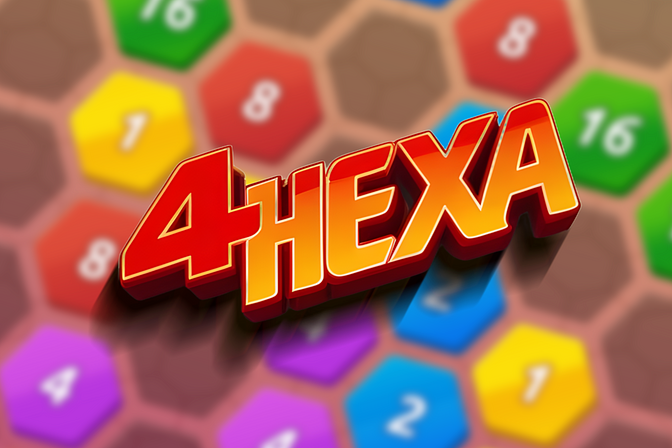
4 Hexa
Play 4 Hexa online free at racing-limits.io. Jump into instant browser gameplay with no downloads.
4 Hexa is a hexagonal tile merging game that operates on a principle immediately familiar to fans of number merge puzzles but distinct in its specific mechanic: rather than sliding tiles in rows, you move individual hexagons to adjacent positions and merge groups of four or more identical values into a single higher-value hexagon. Every merge scores points, returns an extra move, and — critically — frees space on the board. Losing space is the game's primary failure condition, and space management is therefore the central strategic discipline.
The four-tile minimum for a merge creates a meaningful challenge that two-tile merge games don't have. You can't simply place identical tiles adjacent and merge immediately — you need to accumulate and position four of the same value in a configuration that the move rules allow you to connect. This accumulation requirement creates a planning horizon: where are your matching tiles going to converge, how many moves will it take, and does the board have space to support that convergence without losing so much room that you can't continue before the merge triggers?
The penalty for ineffective moves adds a second layer of pressure. Each move that doesn't trigger a merge adds five new tiles to the board — a significant space cost that accelerates toward the game-ending condition where no moves remain possible. This means every move must be evaluated against whether it advances a merge or simply consumes space. The coin and bomb economy — earned through merges, spent on board-clearing assistance — provides emergency tools when the accumulation is blocked and the space pressure is becoming critical. 4 Hexa is a game of patient accumulation, careful positioning, and decisive merge execution, with the board's space serving as the resource that determines how much patience you can afford.
Key Details:
Genre:
Hex Tile Merging / Strategy Puzzle
Difficulty Level:
Medium–Hard
Average Play Time:
10–20 minutes per session
Best For:
Strategy puzzle players who enjoy tile merging games with spatial planning, resource management, and a penalty system that makes every move consequential
How to Play 4 Hexa?
Getting Started:
Click a tile to select it, then click the destination to move it — tiles can only move to positions reachable via a clear unblocked path.
When 4 or more identical-value tiles come together in adjacent positions, they automatically merge into a single tile worth four times the original value.
Each successful merge scores points, returns an extra move, and clears space on the board.
If a move doesn't trigger any merges, 5 new tiles are added to the board — a significant space penalty.
Spend coins earned from merges on bombs or shuffles when space pressure is becoming critical.
Basic Controls:
Input
Action
Click tile
Select tile to move
Click destination
Move selected tile to destination
Bomb (coins)
Destroy one or more tiles to free space
Shuffle (coins)
Rearrange board tiles to expose new merge paths
Objective: Merge groups of 4 or more identical tiles to score points and maintain board space. Prevent the board from filling completely by executing merges before space runs out. Use coin-purchased bombs and shuffles when merge opportunities are blocked and space pressure requires emergency intervention.
4 Hexa Game Features & Highlights
Four-tile minimum merge requirement — creating a merge requires accumulating and positioning 4+ identical tiles, creating a meaningful planning horizon
Move penalty system — non-merge moves add 5 new tiles to the board, making every move's merge-advancement value consequential
Extra-move merge reward — each successful merge returns a move, rewarding efficient play with sustained game continuation
Coin and bomb economy — merges earn coins; coins buy bombs (destroy tiles) and shuffles (rearrange board) for emergency space management
Hexagonal tile layout — six-directional adjacency creates a wider merge convergence possibility space than square-grid alternatives
4 Hexa Tips & Strategies
Beginner Tips:
Plan merge convergence paths before moving the first tile — a merge requires 4 tiles of the same value reaching adjacent positions. Before moving any tile, trace the path by which 4 matching tiles can converge and confirm the moves required don't consume more space than the merge will return.
Prioritize merge-advancing moves over positional reorganization — every non-merge move costs 5 tiles of board space. Moves that don't directly advance a pending merge are expensive. Only move tiles toward established merge convergence goals rather than improving general board organization without a specific merge target.
Identify your highest-value tiles first — high-value tiles are the result of previous merges and are typically the most difficult to accumulate four of. Knowing where your highest-value matching tiles are and what path would bring them together focuses your strategic attention where the highest-value merges are.
Advanced Strategies:
Set up multiple simultaneous merge conditions — having two or three separate four-tile merge groups converging simultaneously means that when one merges, the extra move returned can be used to complete another rather than being spent on board reorganization. Maintaining multiple merge-ready groups in progress simultaneously is the mid-game efficiency that sustains long sessions.
Use bombs surgically, not reactively — coins for bombs are finite. Using a bomb the moment space pressure appears is less efficient than identifying which specific tile, if removed, would create the most valuable chain reaction of cleared space and enabled merges. The best bomb targets are tiles that are blocking merge convergence paths, not just any tile in a crowded area.
Shuffle when the board has high-value same-tile density — shuffles rearrange all tiles into a new configuration. The value of a shuffle depends on what tiles are on the board: a board dense with high-value same-color tiles that are spread across the board gains more from a shuffle (which might accidentally cluster matching tiles) than a board with many different tile values scattered across it.
What to Watch Out For:
Space depletion from exploratory non-merge moves — the temptation to move tiles to "set up future possibilities" without a specific immediate merge target produces 5-tile space additions for each move. These additions compound quickly if several exploratory moves are made in sequence, creating a space crisis before any merge is triggered.
High-value tile isolation — as the board fills with lower-value tiles from penalties, high-value tiles can become isolated from their partners by layers of different-value tiles that block merge convergence paths. Identify forming isolation before it's complete and spend moves clearing the blocking tiles through lower-value merges before the high-value path is completely blocked.
4 Hexa Game Elements Explained
Four-Tile Merge Mechanic: The four-tile minimum merge requirement is 4 Hexa's defining mechanic and the primary source of its strategic depth beyond simpler two-tile merge games. Accumulating four of the same tile value in positions that can be connected requires planning across multiple moves rather than the immediate adjacency-based merging that two-tile games allow. The hexagonal grid's six-directional adjacency expands the number of possible convergence configurations compared to square grids — a tile has six potential adjacent merge partners rather than four — but the six-directional expansion also means the board can develop more complex blocking configurations that create harder-to-resolve isolation situations. The merge product — a single tile worth four times the original value — is immediately available for further merging if three more of the same high value are present, creating the possibility of cascade merges that are the game's highest-scoring single events.
Move Penalty System: The five-tile addition for non-merge moves is the mechanic that makes every tile movement in 4 Hexa a strategic decision rather than a casual repositioning. Unlike merge games where moving tiles without triggering a merge has no cost, 4 Hexa treats each non-merge move as a board depletion event — the available space decreases by approximately five usable positions with each wasted move. This penalty creates the game's core tension: every move must be evaluated for its merge-advancement value, and moves that only reorganize the board without advancing a specific merge create space costs that may not be recoverable before the next merge triggers. The game effectively rewards a sequential approach — identify a merge target, execute only the minimum moves required to trigger it, and then identify the next merge target — over any approach that involves undirected tile movement.
Coin & Emergency Tool Economy: The coin system in 4 Hexa creates a secondary resource management layer that interacts with the main board management challenge. Coins are earned from successful merges — the more merges completed, the more coins available. Coins purchase two types of emergency assistance: bombs, which destroy one or more targeted tiles and free the space they occupied; and shuffles, which rearrange all tiles into a new configuration, potentially exposing merge opportunities that the current layout had blocked. Both tools are most valuable in specific crisis situations — bombs when a specific blocking tile is preventing a high-value merge convergence; shuffles when the general tile distribution has created a board state where no efficient merge paths are visible. Hoarding coins against potential future crises rather than spending them on minor space issues is the resource management discipline that ensures emergency tools are available when they're genuinely decisive.
4 Hexa Frequently Asked Questions
Q: How do I trigger a merge in 4 Hexa? A: Move identical-value tiles into adjacent positions until 4 or more of the same value are touching. The merge triggers automatically when the adjacency condition is met. Tiles can only be moved to positions reachable via a clear unblocked path — plan your convergence route to avoid blocked movement paths.
Q: What happens when I make a move that doesn't trigger a merge? A: 5 new tiles are added to the board — a significant space penalty. This makes every non-merge move expensive. Only move tiles when the movement directly advances a pending merge convergence; avoid exploratory moves without a specific merge target.
Q: How do I earn coins and what can I spend them on? A: Coins are earned from each successful merge. Spend them on bombs (destroy specific tiles to free space or clear blocking tiles) or shuffles (rearrange all board tiles into a new configuration to expose blocked merge opportunities). Save coins for genuine crisis situations rather than spending them on minor space issues.
Q: Is 4 Hexa compatible with mobile devices? A: 4 Hexa uses click-to-select and click-to-move controls that translate to tap input on mobile touchscreen devices. Tap a tile to select it, then tap the destination to move it. The game is fully playable on mobile browsers.
Q: When should I use a shuffle vs. a bomb? A: Use a bomb when a specific tile is blocking a high-value merge convergence path — the bomb's surgical precision solves a targeted problem. Use a shuffle when the general board distribution has created a situation where no efficient merge paths are visible, and a full rearrangement might expose new matching-tile adjacencies that the current layout is hiding.
Related Games Like 4 Hexa You Might Enjoy
If you like 4 Hexa, you might also enjoy:
Hexa Sort Trick Or Treat - It offers a related skill loop where timing, planning, or steady improvement matters.
Tilemanio - It offers a related skill loop where timing, planning, or steady improvement matters.
Geoguessr - It offers a related skill loop where timing, planning, or steady improvement matters.

 Drift Frenzy
 Drift Rush
 Arcade Glide
 Track Dash
 Retro Rush
 Escape Road 3
 Wave Rider
 Traffic Road
 Escape Road City 2
 Bike Xtreme
 Escape Road 2
 Traffic Rally
 Tap Drift
 Drive Mad
 Wheelie Master
 Wheelie Party
 Moto X3M
 Street Wheelie
 Car Chaos
 Escape Drive
 Blocky Rider
 Mad Pursuit
 Mad Racers
 Chase Rush
 Smashy Road
 Driftio
 Night City Racing
 Hill Climb Racing
 Drift Hunters
 Smash Karts
 GT Cars Mega Ramps
 Motorcycle Racer Road Mayhem
 Funny Mad Racing