Drag + Drop: Place hex block from inventory to grid
Hint Button: Reveal the next logical placement
Swap Button: Exchange positions of two inventory blocks
Shuffle Button: Reorganize all inventory blocks
High Score Tips
Map inventory to board before placing anything — count how many blocks of each color are in your inventory and how many spaces of each color the board requires. If the numbers don't match, the level has a configuration issue that hints or shuffles might resolve before any placements create further complications.
Place corner and edge pieces first — hexagonal corners and edge positions on the grid have fewer neighboring spaces, which makes them easier to visualize correct placement for. Filling corners and edges first simplifies the interior placement decisions by reducing the number of configuration possibilities.
Never place a block that creates an isolated space of a color you don't have — before placing any block, check whether doing so would leave a surrounded empty space of a color not present in your remaining inventory. An isolated space that can't be filled is a dead end — avoid creating it.
Hexa Sort Trick Or Treat
Play Hexa Sort Trick Or Treat online free at racing-limits.io. Jump into instant browser gameplay with no downloads.
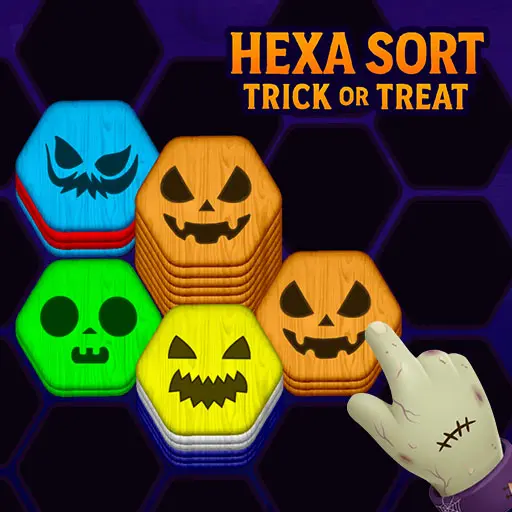
Hexa Sort: Trick or Treat is a hexagonal block placement puzzle wrapped in a Halloween aesthetic that earns genuine atmosphere rather than just slapping pumpkins on a generic interface. The slightly creepy visual design — dark environments, spooky characters, and Halloween-themed color palettes — gives the game a distinctive personality that makes the puzzle experience feel appropriately seasonal. The puzzle itself, however, is the serious business: placing hex blocks into a hexagonal grid, matching colors to their designated positions, without running out of inventory or leaving unfillable gaps.
The game's core challenge is forward planning. Unlike match-3 games where swapping reveals new options dynamically, Hexa Sort presents you with a fixed inventory of hex blocks that must all find their correct positions on the board. Place incorrectly and you may run out of blocks before the board is complete, or create a configuration where the remaining blocks can't fill the remaining spaces. This makes each level a genuine logic puzzle: understanding the board's required color pattern, mapping your available inventory to those requirements, and placing blocks in an order that doesn't create irrecoverable dead ends.
The three support tools — hints, swaps, and shuffles — reflect the game's honesty about the challenge's complexity. Even careful players encounter situations where the remaining inventory and remaining board spaces don't obviously connect, and the support tools provide legitimate assistance when the pure logic path isn't visible. Hints reveal the next logical placement; swaps allow rearranging two inventory positions; shuffles reorganize the full inventory to expose new placement opportunities. These tools typically cost in-game resources, creating a secondary economy around when their value justifies the cost. Hexa Sort: Trick or Treat is a puzzle game that takes its players seriously — the challenge is real, the aesthetic is charming, and the logical depth rewards players who engage with it fully.
Key Details:
Genre:
Hexagonal Block Placement Puzzle
Difficulty Level:
Medium–Hard
Average Play Time:
15–30 minutes per session
Best For:
Puzzle enthusiasts who enjoy spatial logic challenges, players who like themed puzzle games, and anyone who finds the Tetris-to-level-completion format satisfying
How to Play Hexa Sort Trick Or Treat?
Getting Started:
Observe the hexagonal grid and identify the color pattern required — each empty space has a designated color that must be filled.
Review your hex block inventory — a collection of colored hex blocks waiting to be placed.
Drag and drop hex blocks from the inventory to the correct position on the grid — each block must land in a space that matches its color.
Once placed, blocks are fixed and cannot be moved — plan each placement carefully before committing.
Complete the board entirely without errors or gaps to advance to the next level.
Basic Controls:
Input
Action
Drag + Drop
Place hex block from inventory to grid
Hint Button
Reveal the next logical placement
Swap Button
Exchange positions of two inventory blocks
Shuffle Button
Reorganize all inventory blocks
Undo / Reset
Reverse a placement or restart the level
Objective: Place all hex blocks from your inventory into their correct color-designated positions on the hexagonal grid without errors, overlaps, or unfillable gaps. Complete every space correctly to unlock the next level. Blocks placed incorrectly cannot be moved — forward planning before each placement is essential.
Hexa Sort Trick Or Treat Game Features & Highlights
Immovable placement rule — once placed, blocks cannot be repositioned, creating a genuine forward-planning puzzle rather than a trial-and-error matching game
Halloween visual design — spooky atmosphere, pumpkin imagery, and dark seasonal aesthetics create a genuinely distinctive puzzle environment
Three support tools — Hint, Swap, and Shuffle provide legitimate assistance with resource costs that create a secondary decision economy
Progressive board complexity — later levels feature irregular grid shapes, non-adjacent empty spaces, and tighter placement constraints
Completion percentage display — visual feedback on board completion progress keeps each level's remaining challenge clearly visible
Hexa Sort Trick Or Treat Tips & Strategies
Beginner Tips:
Map inventory to board before placing anything — count how many blocks of each color are in your inventory and how many spaces of each color the board requires. If the numbers don't match, the level has a configuration issue that hints or shuffles might resolve before any placements create further complications.
Place corner and edge pieces first — hexagonal corners and edge positions on the grid have fewer neighboring spaces, which makes them easier to visualize correct placement for. Filling corners and edges first simplifies the interior placement decisions by reducing the number of configuration possibilities.
Never place a block that creates an isolated space of a color you don't have — before placing any block, check whether doing so would leave a surrounded empty space of a color not present in your remaining inventory. An isolated space that can't be filled is a dead end — avoid creating it.
Advanced Strategies:
Work from the most constrained spaces outward — spaces with only one or two inventory blocks that could legally fill them are your highest-priority placements. Multiple options can wait; single-option spaces are forced placements that don't consume decision bandwidth.
Use Hints to verify your logic, not replace it — Hint reveals the next logical placement, but understanding why that placement is correct is more valuable than simply executing it. After a Hint, take a moment to confirm why that placement was the logical choice — the reasoning may apply to subsequent placements without requiring another Hint.
Shuffle as a planning reset, not a panic response — when the remaining inventory and board configuration seem incompatible, Shuffle reorganizes the inventory to expose new placement angles. Used thoughtfully when you've exhausted your current planning approach, Shuffle provides a fresh perspective without undoing existing placements.
What to Watch Out For:
Inventory depletion before board completion — the most common failure mode in Hexa Sort is running out of specific color blocks before all spaces of that color are filled. This typically results from using a specific-color block in an optional position (where a different color would also work) when it was actually needed for a forced position later. Prioritize forced placements over optional ones.
Non-adjacent isolated spaces in later levels — advanced board configurations sometimes include spaces that are not connected to the main board cluster but still require filling. These isolated spaces are easy to overlook during the main board placement sequence. Scan the full board at the start of each level to identify all spaces, including isolated ones, before beginning.
Hexa Sort Trick Or Treat Game Elements Explained
Immovable Placement Rule: The fixed-placement rule is Hexa Sort's most consequential design decision — once a hex block is placed on the board, it cannot be moved or removed without using the Undo feature (which typically has limited uses or costs resources). This rule transforms the puzzle from a rearrangement game into a genuine forward-planning challenge. Every placement is a commitment: the available inventory decreases by one block, the available board space decreases by one position, and the resulting configuration must be workable for all subsequent placements. Experienced Hexa Sort players develop a "preview before commit" habit — mentally tracing the next two or three placements from any current position before dragging a block to the board — because recovering from a committed misplacement through Undo or support tools costs more resources than avoiding the error through planning.
Color Matching System: The hexagonal grid in Hexa Sort: Trick or Treat has each empty position pre-designated with a required color — every space must be filled with a block of the exact matching color. This color-to-position matching creates a deductive logic dimension: given the board's required color pattern and the inventory's available blocks, the correct placement sequence can be logically derived rather than guessed. Some positions accept only one specific inventory block (a forced placement); others could accept multiple inventory blocks of the same color (choice placements). Identifying and executing forced placements before choice placements is the sequencing discipline that prevents the inventory from being depleted in ways that leave forced placements without available blocks. The Halloween color palette applied to this system — deep purples, oranges, blacks, and seasonal greens — gives the matching challenge a visual identity that's immediately distinctive and appropriately atmospheric.
Support Tool Economy: The three support tools in Hexa Sort — Hint, Swap, and Shuffle — operate within a resource economy that creates meaningful decisions about when to use them. Hint reveals the next logical placement but costs resources; using multiple Hints per level depletes the resource pool that could be saved for more difficult subsequent levels. Swap exchanges two inventory blocks' positions — most useful when a specific block needs to be placed next but is in a position within the inventory that makes it visually inaccessible. Shuffle reorganizes all inventory blocks into a new arrangement — useful when the current inventory order creates cognitive difficulty in identifying which blocks are available and where. The resource cost of each tool makes their deployment decisions genuinely strategic: a Hint used to confirm an already-logical placement wastes the resource; a Hint used to escape a genuinely stuck configuration provides value proportional to the cost.
Hexa Sort Trick Or Treat Frequently Asked Questions
Q: Can I move a hex block after I've placed it on the board? A: No — once placed, hex blocks are fixed and cannot be moved. If you need to undo a placement, use the Undo button (if available and not already depleted). Plan each placement carefully before committing — the fixed-placement rule is what makes Hexa Sort a planning puzzle rather than a trial-and-error game.
Q: What should I do if my inventory doesn't seem to have the right blocks? A: First, count your inventory colors against the board's required colors to confirm a genuine mismatch. If mismatched, use Shuffle to reorganize the inventory — sometimes the appearance of mismatch comes from visual organization rather than actual color absence. If the mismatch is confirmed after Shuffle, Hint may reveal a placement sequence that resolves the apparent contradiction.
Q: What's the difference between Swap and Shuffle? A: Swap exchanges the positions of two specific blocks in the inventory — use it when a specific block needs to be moved to a more accessible inventory position. Shuffle randomizes all inventory block positions into a new arrangement — use it when the full inventory organization is unhelpful and you need a fresh visual perspective on your available blocks.
Q: Is Hexa Sort: Trick or Treat compatible with mobile devices? A: Yes — the drag-and-drop placement mechanic translates naturally to touch input on mobile devices. Drag a hex block from the inventory area and drop it onto the desired grid position. The game is fully playable on mobile browsers.
Q: Why does the game end before I've placed all my blocks? A: If the remaining board spaces cannot accommodate any of the remaining inventory blocks — due to color mismatch, shape incompatibility, or isolated spaces — the level ends unsuccessfully. This typically results from earlier placements that used specific-color blocks in optional positions, leaving forced later positions without the correct inventory block available. Review your placement sequence and identify where the resource commitment went wrong to improve the next attempt.
Related Games Like Hexa Sort Trick Or Treat You Might Enjoy
If you like Hexa Sort: Trick or Treat, you might also enjoy:
4 Hexa - It offers a related skill loop where timing, planning, or steady improvement matters.
Tilemanio - It offers a related skill loop where timing, planning, or steady improvement matters.
Geoguessr - It offers a related skill loop where timing, planning, or steady improvement matters.

 Drift Frenzy
 Drift Rush
 Arcade Glide
 Track Dash
 Retro Rush
 Escape Road 3
 Wave Rider
 Traffic Road
 Escape Road City 2
 Bike Xtreme
 Escape Road 2
 Traffic Rally
 Tap Drift
 Drive Mad
 Wheelie Master
 Wheelie Party
 Moto X3M
 Street Wheelie
 Car Chaos
 Escape Drive
 Blocky Rider
 Mad Pursuit
 Mad Racers
 Chase Rush
 Smashy Road
 Driftio
 Night City Racing
 Hill Climb Racing
 Drift Hunters
 Smash Karts
 GT Cars Mega Ramps
 Motorcycle Racer Road Mayhem
 Funny Mad Racing