Jump when the cactus is still approaching, not when it's adjacent — the most common beginner timing error is jumping too late, when the cactus is already dangerously close. Initiate your jump with comfortable lead distance while the cactus is still approaching rather than reactive to its arrival.
Classify birds before responding — when a bird appears, determine whether it's flying high (duck) or low (jump) before pressing any key. The wrong response to a bird is just as lethal as no response. A brief identification moment before acting is always safer than an instinctive but potentially incorrect response.
Focus your attention ahead of the dinosaur, not at it — the dinosaur's current position is less useful information than what's appearing at the right edge of the screen. Training your gaze to stay slightly ahead of the dinosaur gives you more reaction time for each incoming obstacle.
Dinosaur Game
Play Dinosaur Game online free at racing-limits.io. Jump into instant browser gameplay with no downloads.
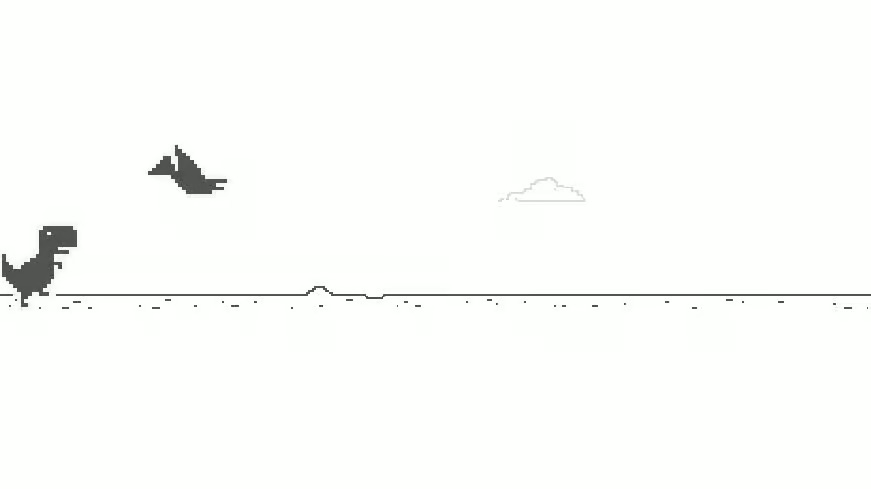
The Dinosaur Game is one of the most widely encountered arcade games in the world — not because it was designed for widespread play, but because it appears automatically in Google Chrome whenever your internet connection drops. The pixelated T-Rex running through a monochrome desert has become the accidental mascot of offline browsing, and the game hidden inside that disconnect screen has earned genuine affection from players who discovered it by surprise and kept coming back by choice.
The game's premise is perfectly minimal: a dinosaur runs automatically, the world scrolls past, and obstacles appear that must be avoided through jumping and ducking. Cacti require jumps of correct height and timing. Birds, which appear at higher score levels, require either a jump over them if they're flying low, or a duck to pass beneath them if they're flying high. The score climbs continuously with survival time, and the world moves progressively faster, compressing the reaction window until even experienced players eventually meet an obstacle at a speed that didn't allow for the correct response.
What makes the Dinosaur Game endure beyond its accidental origin is the precision of its core loop. The jumping physics are clean and consistent — the same jump initiated at the same distance from the same cactus type produces the same outcome every time. This consistency means that failures are always readable: the jump was too late, or too early, or the wrong height, or a bird that required ducking got a jump instead. That readability is what makes "one more try" feel productive rather than futile. The Dinosaur Game offers the same satisfaction as any arcade classic — a simple, fair challenge that rewards practice with measurable improvement.
Key Details:
Genre:
Endless Runner / Arcade Classic
Difficulty Level:
Easy start, Very Hard at high scores
Average Play Time:
3–10 minutes per run
Best For:
All ages; casual players, fans of the original Chrome game, and anyone who enjoys the personal best chase of a simple, precisely-designed endless runner
How to Play Dinosaur Game?
Getting Started:
Press Spacebar or the Up Arrow to start the run — the dinosaur begins moving automatically.
Press Spacebar or Up Arrow again to jump when a cactus or low-flying bird appears ahead.
Press the Down Arrow to duck beneath high-flying birds.
Survive as long as possible — your score increases continuously with time survived.
On mobile, tap the screen to jump. Ducking on mobile may require a swipe downward.
Basic Controls:
Input
Action
Spacebar / Up Arrow
Start game / Jump
Down Arrow
Duck (avoid high birds)
Screen Tap (mobile)
Jump
Objective: Run as far as possible by jumping over cacti and ducking under birds without collision. Your score reflects your survival time — set a personal best distance record. The game ends on any obstacle collision.
Dinosaur Game Game Features & Highlights
Iconic Chrome browser origin — the hidden offline game that became a global phenomenon played by millions who discovered it accidentally
Two-action obstacle system — jump for ground obstacles and low birds, duck for high birds, requiring obstacle classification before responding
Consistent, readable physics — same jump timing from same distance produces same result every time, making failures understandable and improvement measurable
Progressive speed escalation — the game continuously increases speed, ensuring every run becomes more demanding over time with no upper difficulty limit
Day/night cycle at high scores — the background switches between day and night modes at 700+ score, adding visual variety and a subtle visibility challenge
Dinosaur Game Tips & Strategies
Beginner Tips:
Jump when the cactus is still approaching, not when it's adjacent — the most common beginner timing error is jumping too late, when the cactus is already dangerously close. Initiate your jump with comfortable lead distance while the cactus is still approaching rather than reactive to its arrival.
Classify birds before responding — when a bird appears, determine whether it's flying high (duck) or low (jump) before pressing any key. The wrong response to a bird is just as lethal as no response. A brief identification moment before acting is always safer than an instinctive but potentially incorrect response.
Focus your attention ahead of the dinosaur, not at it — the dinosaur's current position is less useful information than what's appearing at the right edge of the screen. Training your gaze to stay slightly ahead of the dinosaur gives you more reaction time for each incoming obstacle.
Advanced Strategies:
Learn cactus cluster approach distances — cacti appear individually or in clusters of two or three. Clusters require earlier jump initiation than individual cacti because the obstacle footprint is wider. Developing a consistent "jump here for this cactus type" distance instinct — rather than reacting each time — is the habit that produces the most reliable high scores.
At high speeds, duck birds proactively rather than reactively — when the game is running fast, high-flying birds appear and require ducking in a window that's uncomfortable for reactive response. Identifying that a bird is incoming and ducking slightly before you've confirmed its exact height — then releasing if it turns out to be low — is faster than waiting for height confirmation.
Accept the day/night visual transition gracefully — the background switch at 700+ score can briefly disorient players who aren't expecting it. Knowing it happens at that score threshold removes the surprise factor and prevents the visual transition from causing a startled reaction that disrupts your obstacle timing rhythm.
What to Watch Out For:
Tall cactus clusters at speed — tall multi-cactus clusters at high game speed require both correct timing (early enough to clear the first cactus) and correct jump height (enough arc to clear the tallest cactus). Players whose jump timing is calibrated for single small cacti consistently clip the tops of tall clusters at speed.
Low birds immediately after cacti — some obstacle sequences place a bird shortly after a cactus, meaning your landing from the cactus jump puts you on a collision course with the bird if the bird is at the dinosaur's landing height. At high speeds this sequence appears faster than comfortable reaction time allows — developing instincts for post-jump bird awareness is a key late-game skill.
Dinosaur Game Game Elements Explained
Two-Obstacle System: The Dinosaur Game's obstacle design is deceptively sophisticated for a game of its visual simplicity. Cacti are the primary ground hazard — they vary in height (tall and short) and grouping (single, double, or triple cluster) — and require a jump to clear. Birds appear after higher scores and occupy two possible altitude positions: low altitude (at body height, requiring a jump to clear or duck to pass under) and high altitude (above jump height, requiring a duck to pass beneath). The critical skill demand is obstacle classification — identifying which type of response each obstacle requires before executing it. A wrong response (jumping at a high bird, ducking at a low bird, jumping too early, or ducking when a jump was needed) produces the same collision as any other failure. This classification requirement, executed under increasing speed, is what elevates the game beyond simple button-mashing.
Progressive Speed System: The Dinosaur Game's speed escalation is continuous and uncapped — the game moves faster with every passing moment of survival and never reaches a plateau at which the pace stops increasing. This escalation is the game's primary difficulty mechanism: the same obstacle at low speed gives comfortable reaction time; the same obstacle at high speed compresses that time significantly. The specific challenge this creates is that habits and timing instincts calibrated to earlier speeds become inadequate at later speeds without conscious recalibration. Players who jump at a consistent distance from cacti find that distance becoming too close as the game speeds up, requiring earlier jump initiation that feels counterintuitively premature relative to their established habit. Developing a sense of "earlier than comfortable" timing at high speed is the specific adaptation that long runs require.
Day/Night Visual System: At score thresholds of approximately 700 points and beyond, the Dinosaur Game's background switches periodically between day mode (white background, dark obstacles) and night mode (dark background, light obstacles). This visual inversion adds a subtle challenge beyond the obstacle timing itself: at the moment of transition, the sudden change in background contrast can briefly disrupt visual processing as the eye adjusts to the inverted color scheme. The obstacles remain identical in shape and behavior — only their visual presentation changes. Players who are aware that this transition occurs at high score thresholds can anticipate and accommodate it; players encountering it for the first time without warning sometimes react to the visual change rather than the obstacles, producing an avoidable collision.
Dinosaur Game Frequently Asked Questions
Q: How do I start the Dinosaur Game? A: Press Spacebar or the Up Arrow key to begin — the dinosaur starts running and the first jump is initiated simultaneously. On mobile, tap the screen to start. The game begins immediately on your first input.
Q: When should I duck instead of jump? A: Duck using the Down Arrow when a high-flying bird appears that's above the dinosaur's body height but within the jump arc. If the bird is flying at body level or below, jump over it instead. The key is classifying the bird's altitude before responding rather than reacting with the same input to all birds.
Q: Is the Dinosaur Game the same as the Chrome offline game? A: Yes — this is the same dinosaur running game that appears in Google Chrome when your internet connection is unavailable. This version is playable at any time directly in your browser without requiring an internet outage.
Q: Is the Dinosaur Game compatible with mobile devices? A: Yes — tap the screen to jump on mobile touchscreen devices. The game is compatible with mobile browsers. Ducking on mobile may require a swipe-down gesture depending on the implementation.
Q: Does the game get harder indefinitely? A: Yes — the Dinosaur Game's speed increases continuously without a maximum cap. Every surviving second makes the next obstacle harder to react to than the previous one. Personal best scores are genuinely competitive achievements because the game actively works to exceed your reaction capability the longer you survive.
Related Games Like Dinosaur Game You Might Enjoy
If you like Dinosaur Game, you might also enjoy:
Dino Dash 3D - It has the same fast-restart arcade rhythm and rewards sharper timing.
Kawairun 2 - It has the same fast-restart arcade rhythm and rewards sharper timing.
Sprunki Phase 5 - It has the same fast-restart arcade rhythm and rewards sharper timing.

 Drift Frenzy
 Drift Rush
 Arcade Glide
 Track Dash
 Retro Rush
 Escape Road 3
 Wave Rider
 Traffic Road
 Escape Road City 2
 Bike Xtreme
 Escape Road 2
 Traffic Rally
 Tap Drift
 Drive Mad
 Wheelie Master
 Wheelie Party
 Moto X3M
 Street Wheelie
 Car Chaos
 Escape Drive
 Blocky Rider
 Mad Pursuit
 Mad Racers
 Chase Rush
 Smashy Road
 Driftio
 Night City Racing
 Hill Climb Racing
 Drift Hunters
 Smash Karts
 GT Cars Mega Ramps
 Motorcycle Racer Road Mayhem
 Funny Mad Racing